On this page
Yes, you can fit air conditioning in a flat. "Air conditioning units are not banned," a government spokesperson said in June 2026. What makes air conditioning in flats harder than in a house is that three parties can say no: the freeholder under your lease, the council under planning rules, and your neighbours through noise. In England, a block of flats can use the permitted development right for one reversible unit of no more than 0.6 cubic metres, but a cooling-only unit cannot. Read the lease first, check planning second, then pick the system.
Last checked 10 October 2026 against the primary sources listed at the end. Planning rules are for England. This is general information, not legal advice.
- Read your lease for the alterations covenant and who owns what.
- Check planning for your flat (in England, Class G).
- Pick a system that needs the fewest permissions.
- Test the noise against the 37 dB rule.
- Price the job, including what a flat adds.
- Check the installer's F gas certification before paying.
Who can say no to air conditioning in a flat?
The freeholder controls the building through your lease, the council controls the outside through planning, and neighbours can complain about noise. Take them in that order, because the lease can stop everything else and is the cheapest to read. Dee Aylward, a partner at Mishcon de Reya, wrote in July 2026: "The key message is simple: do not instruct a contractor before taking advice."
Step 1: Read your lease
What you own, and what you do not
Your lease grants a "demise", the part you hold. Mishcon says it will usually exclude the structure of the building, which covers the external walls where a refrigerant pipe and outdoor unit tend to go.
Absolute or qualified covenant
Look for the clause on alterations. Mishcon says most residential leases restrict them, that depending on the wording the landlord may be under no obligation to consent at all, and that some leases or building rules may prohibit air conditioning altogether.
A qualified covenant lets you make alterations with consent. Section 19(2) of the Landlord and Tenant Act 1927 says that where a lease bars improvements without consent, consent is "not to be unreasonably withheld", and the landlord can ask for a reasonable sum for damage and for legal expenses properly incurred. It does not rescue an absolute covenant.
When every lease in the block says the same
In Duval v 11-13 Randolph Crescent [2020] UKSC 18, about a block of nine flats in Maida Vale, the Supreme Court held that a landlord could not license works breaching an absolute covenant where the other leases let any lessee require the landlord to enforce it. So a willing freeholder can be unable to say yes. The case construed those leases; it is not a general rule.
What to put in the request
Send the unit make and model, the outdoor unit position with a photograph or drawing, the pipe route and drilling point, the noise data, the installer's F gas certificate, and an offer to make good any damage.
Costs and time
Mishcon says consent can take time and usually involves paying the landlord's legal and surveyor's costs. We found no reliable published fee, so ask the managing agent in writing. If a refusal looks unreasonable, take advice from a solicitor or LEASE.
Step 2: Check planning for your flat
Flats are not excluded from the heat pump rule
A common line is that flats have no permitted development rights. That is true for extensions, because Article 2 of the 2015 Order says "dwellinghouse" does not include a building containing flats. But Class G, the right for air source heat pumps, covers "a dwellinghouse or a block of flats". The legislation.gov.uk text is up to date to 7 October 2026.
The Planning Portal adds one test: "A block of flats must consist wholly of flats (e.g. should not also contain commercial premises)." Rights can also be removed by a planning condition or an Article 4 direction.
Does your unit qualify?
England, Schedule 2, Part 14, Class G, read 10 October 2026.
| Test | Flat rule |
|---|---|
| Number of units | One air source heat pump on or within the curtilage of the block (G.2(a)) |
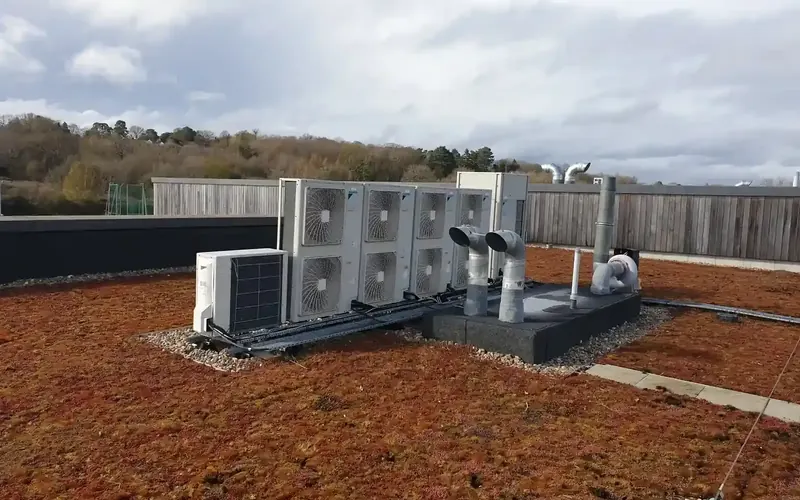
| Size | Outdoor unit no more than 0.6 cubic metres including housing (G.2(d)); a house gets 1.5 |
| Position | Not on a pitched roof, not within 1 m of a flat roof edge, not on a listed building |
| Conservation area | Not on a wall or roof fronting a highway, and not nearer the highway than the block |
| Front wall | Not on a wall fronting a highway above ground floor level |
| Use | Not solely used for cooling (G.3(aa)) |
| Noise | Must comply with MCS 020 a) (G.1) |
The cooling-only trap
Condition G.3(aa), inserted on 29 May 2025, requires that "the air source heat pump is not solely used for the purpose of cooling". The Planning Portal's air conditioning FAQ is blunt: if the system only cools, the rights do not apply and a planning application is required. A reversible model of a similar size can fall within Class G if it meets every other limit.
Grey areas and how to settle them
"Block of flats" is not defined in Article 2, so a converted house or a block with a shop below may not fit. Brighton and Hove council says a certificate of lawful development is the formal confirmation that works are permitted development. Mishcon says air conditioning with pipework and an external condenser will very often trigger listed building consent.
Fees
From 1 April 2026 the fee for alterations to a single dwellinghouse in England is £548, but a flat is not a "dwellinghouse" under Article 2 and the fee table does not say where a flat's condenser falls. Ask your council.
Wales, Scotland and Northern Ireland
Wales updated its rules on 1 June 2026 and excludes cooling-only units, but its guidance page does not mention flats. Scotland's Class 6H covers buildings containing flats. We could not verify Northern Ireland's position for flats. Check with your council.
Step 3: Pick a system that fits the permissions
The less you drill and the less you put outside, the fewer people can say no.
| Type | Consent risk in a flat | Note |
|---|---|---|
| Fixed split | Highest: wall drilled, outdoor unit placed | Which? says splits are quieter and usually more efficient than portables |
| Multi-split | One outdoor unit, more pipework | Fits the one-unit limit in G.2(a) |
| Portable with window hose | Lowest: no drilling | Which? says in most cases a reliable fan will do the job |
Where there is no agreed place for an outdoor unit, a portable may be the only route that needs no consent. Our split system guide and guide to choosing air conditioning for your home cover the trade-offs.
Size it before you ask for consent
Daikin UK's rule of thumb is about 0.1 kW per square metre, so 20 m2 is about 2 kW. It says the South East can need about 20% more than Scotland, and a poorly insulated, sun-facing room needs more, which in a block often means the top floor.
What is the room?
How well insulated is it?
Well insulated: modern build or retrofitted, double glazing. Poor: single glazing, solid walls, uninsulated loft.
How much sun does it get?
Very sunny: big south or west-facing windows with no shade.
Where is it in the building?
You probably need about
2.1kW
7,200 BTU/h of cooling. Range 1.9 to 2.4 kW (6,400 to 8,200 BTU/h).
Closest standard unit
A 2.5 kW unit is the smallest standard size that covers it. Bigger is not better: an oversized unit switches on and off too often, cools unevenly and wastes electricity.
Show the sums
- Floor area: 5.0 × 4.0 = 20.0 m²
- Base load: 20.0 m² × 90 W/m² = 1800 W
- Adjust for ceiling height (×1.00), sun (×1) and floor (×1) = 1800 W
- Extra people: (3 − 2 included, min 0) × 100 W = 100 W
- Heat-giving kit: 200 W
- Total: 2100 W = 2.1 kW (÷ 1,000), or × 3412 = 7,200 BTU/h
- Range: 90% to 115% of that, to allow for what a survey would find.
Where the outdoor unit goes
Daikin's Perfera specification allows 10 m of pipe with no extra refrigerant, then 0.02 kg per metre, up to 20 or 30 m depending on model. On a seafront balcony, note that Toshiba's warranty guidelines say high levels of nitrogen oxides and sulphur dioxide commonly occur within 3 miles of the coast, so ask about coil protection.
Step 4: Noise and your neighbours
The 37 dB test and who counts as a neighbour
Class G depends on the MCS 020 a) noise calculation. The limit is 37 dB LAeq,5mins, measured 1 m outside the centre of any door or window to a habitable room of a neighbouring property. For flats, the standard says: "In instances where the heat pump would be installed on a block of flats, neighbouring property includes flats within the same block of flats". Your own flat is excluded. Passing the test does not on its own give you permitted development rights.
Why the number on the box is not the number at the window
Daikin lists Perfera outdoor units at 46 to 49 dBA sound pressure, nominal. That is a figure for the unit itself. The 37 dB limit applies at a neighbour's window, so distance, walls and position change the result. Ask the installer for the MCS 020 a) calculation for your exact position.
If a neighbour complains anyway
Section 79(1)(g) of the Environmental Protection Act 1990 makes noise from premises that is prejudicial to health or a nuisance a statutory nuisance, and councils must inspect their area for nuisances. Being permitted development does not stop a nuisance complaint.
Step 5: What it costs in a flat
Install cost ranges
| Source | Single split, installed | Date |
|---|---|---|
| Trade2Base | £1,800 to £3,500 | 1 July 2026 |
| Heatable | £2,000 to £3,500 | 7 October 2026 |
Our air conditioning cost guide explains how we set a headline of £1,800 to £3,500. Four Sussex installers advertise single splits from £1,000 to £2,500 (read 10 October 2026). Those are advertised prices, not quotes.
What changes the price in a flat
Heatable gives about £800 to £1,200 per extra indoor unit and £200 to £1,000 for electrical work. Trade2Base puts a two-room system at £3,200 to £5,500. A flat can add access equipment, a longer pipe run and the landlord's fees from Step 1. We found no published price for those.
Running costs
Ofgem's cap for 1 October to 31 December 2026 is 26.32p per kWh. At that rate a 3.5 kW split costs about 10p an hour at SEER 9.25 and about 15p at SEER 6.1. Over the label's 350 cooling hours a year that is roughly £35 to £53. Our running costs guide shows the sum.
Cooling or heating?
On the unit's energy label. New units are often 6 to 8 (SEER) and about 4 (SCOP).
Units rarely run flat out. Half of rated output is a sensible start; hot spells in a sunny room run higher.
Default: 26.32p, the Ofgem price cap average for 1 October to 31 December 2026 (direct debit, standing charge not included). Use your own rate if you are on a fixed or time-of-use tariff. The next cap is announced 25 November 2026.
Roughly
5.4pan hour
Draws about 0.20 kW of electricity while running.
- A day
- 32p
- A month of use
- £9.71
- A year at this use
- £19.42
- Electricity a year
- 74 kWh
Show the sums
- Output while running: 2.5 kW × 50% = 1.25 kW
- Electricity drawn: ÷ 6.1 SEER = 0.20 kW
- Cost an hour: 0.20 kW × 26.32p = 5.4p
- A day: × 6 h = 32p. A year: × 60 days = £19.42
An estimate. SEER and SCOP are seasonal averages from lab tests; real use varies with weather, set temperature and how the room is used. Standing charges, and the cost of buying and installing the unit, are not included.
The £2,500 Boiler Upgrade Scheme grant
Ofgem lists £2,500 off air-to-air heat pumps for residential properties only, in a scheme open in England and Wales. The 2026 regulations say the unit must replace the heat generating components of the original heating system, where applicable. On 10 October 2026 MCS said no installers were yet certified for air-to-air heat pumps, so for now the grant exists on paper. Read our air-to-air heat pump guide before paying for anything on the strength of it.
Step 6: Check the installer before you pay
F gas certification, company and person
GOV.UK says a company must be certified to install, repair or maintain air conditioning containing F gas, by a body such as Refcom, the F-Gas Register (Quidos) or Bureau Veritas UK, renewed every 3 years. Each engineer also needs personal qualifications. Ask for both, and use our F gas register check guide. A register miss is not proof of no certificate, because listing is optional.
What a survey in a flat should cover
Free surveys are common. A survey should measure the rooms, assess insulation and window orientation, and settle the outdoor unit position and pipe route. None of the 39 installers listed on our site states flat or leasehold experience, so ask directly.
If you rent your flat
A fan or blinds need no drilling. A portable with a window hose may be allowed, but the tenancy agreement decides. To ask:
- Read the tenancy agreement for alterations and fixings.
- Ask the landlord in writing, naming the unit and where it goes.
- Offer to make good any marks when you leave.
- Get consent in writing before buying anything.
We found no right for a tenant to fit air conditioning. The first phase of the Renters' Rights Act 2025 began on 1 May 2026 in England, but we found nothing in it on alterations, so the tenancy and the landlord's written consent decide it.
Brighton and Hove: a city of flats
The council's 2021 Census briefing says 50% of Brighton and Hove households (60,754 of 121,401) live in a flat, against 22% in the South East and England. 19.6% live in part of a converted or shared house, against 3.1% in the South East. Converted houses are the Class G grey area from Step 2, and the council says planning controls are tighter in conservation areas. See the Brighton and Hove installer directory for what we found on each firm's F gas status.
Checklist before you book anything
Do not pay a deposit until each line has an answer in writing.
- Lease covenant type noted (absolute or qualified).
- Written consent from the freeholder or landlord.
- Planning route settled: Class G, or a certificate of lawful development.
- Reversible unit, not cooling-only.
- Outdoor unit no more than 0.6 cubic metres including housing, one per block.
- MCS 020 a) noise figure for your position.
- Three itemised quotes for the same specification.
- F gas company certificate and engineer qualification.
- Written warranty and servicing terms.
Start with the first line: email the managing agent and ask for their consent procedure and fees in writing.
Questions
Can you have air conditioning in a flat?
Can the freeholder refuse air conditioning in a leasehold flat?
Do you need planning permission for air conditioning in a flat?
Which air conditioning is best for a flat?
Can I have air conditioning in a rented flat?
How loud is too loud for an air conditioner?
Sources
- MHCLG: Air conditioning rules, 25 June 2026
- Mishcon de Reya: Keeping cool, what to think about before installing air conditioning, July 2026
- GPDO 2015, Schedule 2 Part 14
- GPDO 2015, Article 2
- Planning Portal: Air source heat pump planning permission
- Planning Portal FAQ: Do I need planning permission to add air conditioning
- Landlord and Tenant Act 1927, section 19
- Duval v 11-13 Randolph Crescent Ltd [2020] UKSC 18, press summary
- MCS 020 a) Issue 1.1
- Environmental Protection Act 1990, section 79
- MHCLG: Planning fees from 1 April 2026
- Welsh Government: Planning permission for heat pumps
- Scottish Government: Circular 1/2024
- Department for Infrastructure NI: Heat pump permitted development changes
- Brighton and Hove City Council: When you need planning permission
- Brighton and Hove City Council: Conservation areas
- Brighton and Hove City Council: Census 2021 city profile
- Which?: How to buy an air conditioner
- Which?: Air conditioner or electric fan, 17 August 2026
- Daikin UK: Air conditioner size guide
- Daikin UK: Perfera product profile (PDF)
- Toshiba Air Conditioning UK: Warranty guidelines 2025 (PDF)
- Trade2Base: How to price air conditioning installation
- Heatable: Air conditioning costs
- Ofgem: Energy price cap, 1 October to 31 December 2026
- Ofgem: Boiler Upgrade Scheme
- Boiler Upgrade Scheme regulations 2026, SI 2026/390
- MCS: Air-to-air heat pumps
- GOV.UK: F gas certification for companies
- GOV.UK: Renters' Rights Act 2025 implementation roadmap
Written and checked by Alex Christou. Found a mistake? Tell us; our corrections policy explains what happens next.