On this page
Quick answer. Usually no, if the unit can heat as well as cool, sits on a house in England and stays within the size, position and noise limits. You do need planning permission for a cooling-only unit and for any listed building (plus listed building consent). Conservation areas, flats and leases add further rules, covered below.
This guide is for England, which includes Brighton and Hove. It is general information, not legal advice. Rules change, and the council has the final say on your address. The rules below were checked against the legislation and council pages on 10 October 2026.
The answer for your situation
| Your situation | Permitted development? | What you do |
|---|---|---|
| Reversible (heating and cooling) unit on a house, not in a conservation area, within the limits below | Yes | No application needed. A certificate of lawful development is optional proof. |
| Cooling-only unit | No | Apply for planning permission |
| Unit on a wall facing a road, above ground-floor level (outside a conservation area) | No | Apply for planning permission |
| Unlisted house in a conservation area, unit on the side or back, not nearer the road than the house | Can be | Check the limits and the council's guidance; consider a lawful development certificate |
| Conservation area, unit on a wall or roof facing the road, or nearer the road than the house | No | Apply for planning permission |
| Listed building or its grounds | No | Planning permission and listed building consent |
| Block of flats | Yes, with tighter limits | One unit, 0.6 cubic metres; lease and freeholder consent also needed |
| Property where permitted development rights were removed (Article 4 Direction or earlier planning condition) | No | Apply for planning permission |
What counts as air conditioning in planning law
Planning law has no "air conditioning" class. The rights come from Class G of Part 14 of Schedule 2 to the General Permitted Development Order 2015, which covers the installation, alteration or replacement of a microgeneration air source heat pump on a house or block of flats, or in its grounds.
A reversible air conditioner is an air source heat pump. The Planning Portal's own FAQ on air conditioning says the permitted development rights only apply if the system provides a heating function, including systems that provide both heating and cooling. If the system only cools, the rights do not apply and you need to apply for planning permission. Since 29 May 2025 the legislation says the same: a condition of Class G is that the unit is "not solely used for the purpose of cooling".
So a cooling-only unit is the one type that always needs an application. Buying a reversible model of a similar size removes that need in many cases.
The permitted development limits (England)
The Planning Portal lists the limits and conditions. Each one below matches the text of Class G on legislation.gov.uk.
The unit and the installation must:
- Comply with the Microgeneration Certification Scheme planning standard, MCS 020 a). Since 28 May 2026 it is the only accepted noise standard.
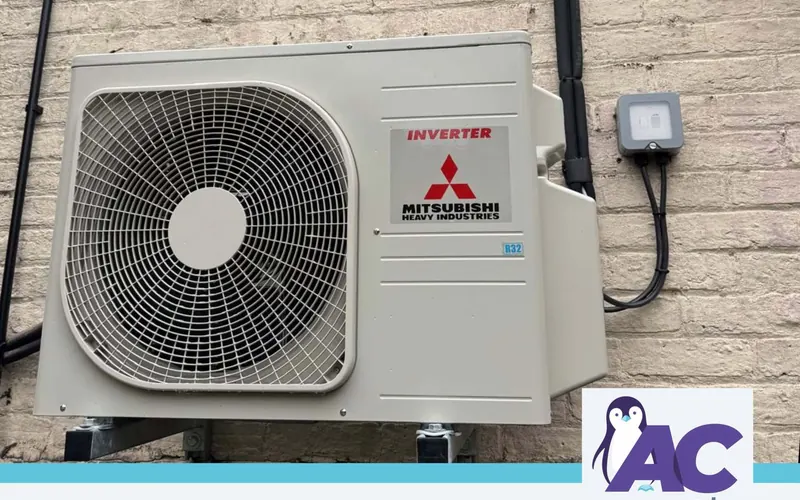
- Have an outdoor compressor unit (including any housing) no larger than 1.5 cubic metres on a house, or 0.6 cubic metres on a block of flats.
- Be the only unit, except on a detached house, where two are allowed. On a block of flats or a house that is not detached, only the first installation is permitted development.
- Not sit on a pitched roof.
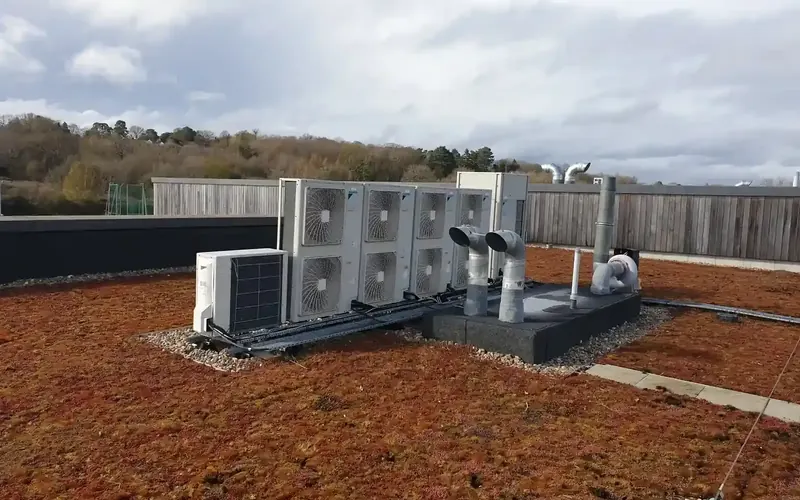
- If on a flat roof, be at least 1 metre from the external edge of that roof.
- Not be at a property with a wind turbine on the building or in its grounds.
- Not be within a scheduled monument site, or in the grounds of a listed building.
Position relative to the road:
- Outside a conservation area or World Heritage Site, the unit cannot go on any part of a wall facing a highway that is above the ground-floor storey.
- In a conservation area or World Heritage Site, the unit cannot go on a wall or roof facing a highway, and cannot be nearer to any bounding highway than the part of the building nearest to it.
Conditions:
- The unit must not be used solely for cooling.
- It must be sited, as far as practicable, to minimise its effect on the building's appearance and on the area's amenity.
- It must be removed as soon as reasonably practicable when no longer needed.
The Planning Portal adds a warning: permitted development rights may be removed by a planning condition or an Article 4 Direction.
The noise limit
MCS 020 a) is a calculation, not a measurement. It tests whether the unit would produce more than 37 dB LAeq,5mins at the assessment positions: a point 1 metre outside the centre of any door or window of a habitable room of a neighbouring property. The installer takes the manufacturer's sound power figure, applies distance and any barrier, and records the result. The standard says passing it does not by itself bestow permitted development rights; the other limits all apply.
Ask your installer for the completed MCS 020 a) calculation in writing before work starts. Keep it with your records. It is your evidence if a neighbour complains.
What changed in 2025 and 2026
The Town and Country Planning (General Permitted Development) (England) (Amendment) Order 2025 (SI 2025/560) came into force on 29 May 2025. For heat pumps it:
- raised the volume limit for a house from 0.6 to 1.5 cubic metres (flats stay at 0.6);
- allowed two units on a detached house;
- omitted the old 1 metre boundary rule;
- added the "not solely used for cooling" condition;
- removed the words "or equivalent standards", so only the MCS standard counts. A transition period let installers finish work that was permitted before the change until the end of 28 May 2026.
Those are the changes we could verify in the legislation. We found nothing else in 2026 that alters these rules.
Brighton and Hove: conservation areas
The council's conservation areas page names 34 areas in the city. They include The Avenues, Brunswick Town, Kemp Town, Montpelier and Clifton Hill, North Laine, Old Hove, Old Town, Preston Park, Regency Square, Round Hill, Valley Gardens and West Hill, as well as outlying areas such as Rottingdean, Patcham, Ovingdean, Portslade Old Village and Stanmer. The council holds an alphabetical street directory of streets that fall wholly or partly inside a conservation area, plus a character statement and map for each.
Check your address first. Open the council's conservation areas page, use the street directory, and open the map for the area if your street is only partly covered.
What the council says about heat pumps
The council's heritage guidance states that an air source heat pump on an unlisted home in a conservation area may be permitted development, subject to criteria, but not if it is installed on a wall or roof that fronts a highway, or nearer to any public highway than the part of the house or block of flats nearest to that highway. Where permission is needed, the council says a unit can be acceptable if the property has a large front garden or the equipment is not visually intrusive from public view, possibly with screening such as planting. It says a unit is unlikely to be acceptable on terraced properties with small front gardens where it would be prominent from the highway.
The page is a technical guidance note, last updated in July 2024, which is before the May 2025 permitted development changes. Read it as the council's guidance, not as a statement of current policy, and check it against the limits above. In practice, many Victorian and Regency terraces have little space away from the road, so a rear or side position is the better bet.
Article 4 Directions
An Article 4 Direction removes permitted development rights for specified work, so a council can require an application for things that would otherwise be allowed. Brighton and Hove has many. The council's page lists directions numbered A4/02 to A4/49, mostly for conservation areas, covering minor work such as porches, replacement windows and doors, roof coverings and painting of exteriors. Most apply to single houses. One (A4/30) covers satellite dishes and other aerials.
The council page does not say whether any direction removes the heat pump class. You cannot tell from a direction's name what it covers, so do not assume a house is clear. Ask the council, or apply for a lawful development certificate.
Listed buildings
Permitted development for heat pumps does not apply to a listed building or to anything in its grounds. You need planning permission and listed building consent. The council states that carrying out works that affect a listed building's special character without consent is a criminal offence, and that listing applies to the interior and exterior of the whole building and its curtilage structures. The council does not list buildings. The government compiles the register on Historic England's advice, and the council publishes a summary of listed buildings in the city and links to the National Heritage List for England.
Mishcon de Reya, a law firm, notes that internal units, pipework and external condenser together will very often trigger consent. Planning permission does not remove the need for listed building consent.
There is no fee for listed building consent (GOV.UK). You still pay for a planning application if one is needed. The council charges a fee for pre-application advice on listed buildings and other schemes.
Flats and leasehold
Planning
Class G covers a "block of flats", and the Planning Portal says a block must consist wholly of flats, so a building that also has commercial premises does not qualify. For a qualifying block, the limits are tighter: one air source heat pump on or within the curtilage, and a maximum volume of 0.6 cubic metres.
The lease
Planning permission and lease permission are separate. Mishcon explains that most residential leases restrict alterations, that the demise (the part you own) usually excludes the structure, and that drilling through an external wall therefore normally needs the landlord's consent. Consent can take time and usually involves paying the landlord's legal and surveyor's costs, and depending on the lease the landlord may be under no obligation to give it. Some leases or building rules prohibit air conditioning entirely. Breach can lead to a claim to remove the unit.
If you rent, Checkatrade says permanent installations such as wall-mounted or ducted systems usually need your landlord's permission, and portable units avoid structural change.
Practical order of work for a leasehold flat:
- Read the lease for alterations and external wall clauses.
- Write to the landlord or managing agent describing the unit, its position, its noise rating and how pipework passes through the wall.
- Ask whether the freeholder must also consent.
- Get consent in writing before you order the unit.
- Then deal with planning.
Earlier planning conditions
Mishcon points out that permitted development can be restricted by a condition on an earlier permission. For example, an extension approved with a flat roof may carry a condition that nothing is placed on that roof. In that case, a condenser on it needs a separate application. If you live in an extension or converted building, search the council's planning register for the property's history.
When and how to apply
Decide before you pay a deposit. Mishcon's advice is simple: do not instruct a contractor before taking advice.
If your project meets every limit above, you can proceed without an application. For formal confirmation that the work is permitted development, the council says you need to apply for a certificate of lawful development (LDC). Separately, Mishcon notes that missing approvals can cause delay or difficulty on a future sale, so a certificate is worth having if you may sell.
Fees
The national fees from 1 April 2026 (GOV.UK):
| Application | Fee |
|---|---|
| Alteration of a single dwellinghouse | £548 |
| Ancillary operations within the grounds of a house | £272 |
| Certificate of lawful development, proposed use or operation | Half the full application fee |
| Listed building consent | No fee |
An air conditioning unit could be treated as an alteration to the house or as an ancillary operation, and we found no council statement on which category applies. Ask Brighton and Hove which fee it will charge before you submit. An LDC for a proposed unit would cost half of whichever fee applies, so £274 or £136 on those figures.
How long it takes
The Planning Portal says most applications are decided within eight weeks, or 13 weeks if unusually large or complex. Ask the council for its own timetable when you submit.
Pre-application advice
The council runs a pre-application advice service and charges a fee for it. It is worth the money on a listed building or in a street where conservation is a live issue.
Enforcement
If you install without permission where it was needed, Mishcon says the usual step is an enforcement notice, typically requiring the unit to be moved or removed. Failing to comply with an enforcement notice is a criminal offence. The council's planning enforcement page explains how it investigates unauthorised changes.
Building regulations
Planning permission is separate from building regulations. Mishcon says a fixed air conditioning system will often need to comply with them and the installer should certify that. The Planning Portal advises using an installer in the Microgeneration Certification Scheme or the relevant competent person scheme. The council has a building regulations page.
A short checklist
- Is the property listed? If yes, start with the council's pre-application service.
- Is it in a conservation area? Check the street directory.
- Is it a flat? Read the lease and write to the landlord.
- Choose a reversible unit unless you are prepared to apply.
- Plan a position that is not on a front wall, not above ground floor facing the road, and away from neighbours' windows.
- Ask the installer for the MCS 020 a) calculation, the volume of the outdoor unit and the number of units.
- Ask the council or apply for an LDC if there is any doubt.
- Keep the paperwork when you sell.
Once the permissions are clear, pick an installer who has done similar jobs on your street type.
our Brighton and Hove installer directory
Related guides: air-to-air heat pumps, split-system air conditioning and air conditioning cost.
Questions
Do I need planning permission for air conditioning?
Is it legal to install AC in the UK? Is air conditioning illegal?
What is the 1 metre boundary rule?
Do air source heat pumps need planning permission?
What are the key planning changes for 2026 that affect air conditioning?
Do I need permission in a Brighton and Hove conservation area?
Can I install air conditioning in a leasehold flat?
How long does a planning application take and what does it cost?
Sources
- legislation.gov.uk: Town and Country Planning (General Permitted Development) (England) Order 2015, Schedule 2, Part 14 (Class G)
- legislation.gov.uk: The Town and Country Planning (General Permitted Development) (England) (Amendment) Order 2025, SI 2025/560
- legislation.gov.uk: GPDO 2015, Schedule 2, Part 14 Class G as it stood on 1 January 2024 (before the 2025 amendment)
- Planning Portal: Planning permission for an air source heat pump
- Planning Portal Interactive House: Do I need planning permission to add air conditioning to my home?
- Planning Portal: How long does it take to get a decision on an application?
- MCS 020 a): Air Source Heat Pump Sound Calculation for Permitted Development Installations, Issue 1.1 (14 Apr 2025)
- Brighton & Hove City Council: Conservation areas
- Brighton & Hove City Council: Article 4 Directions
- Brighton & Hove City Council: Improving energy saving and sustainability in conservation areas and listed buildings (air source heat pump guidance)
- Brighton & Hove City Council: Listed buildings of Brighton & Hove
- Brighton & Hove City Council: When you need planning permission
- Brighton & Hove City Council: Planning applications and pre-application advice
- Brighton & Hove City Council: Building regulations
- GOV.UK: Fees for planning applications in England from 1 April 2026 (indexation table)
- GOV.UK: Fees for planning applications (guidance, applications not subject to a fee)
- Mishcon de Reya: Keeping cool, what to think about before installing air conditioning (8 Jul 2026)
- Checkatrade: Air conditioning in Brighton, FAQs on rented flats (read 10 Oct 2026)
Written and checked by Alex Christou. Found a mistake? Tell us; our corrections policy explains what happens next.