On this page
Quick answer. An air-to-air heat pump is a reversible air conditioner: the same indoor and outdoor units that cool a room in summer heat it in winter. The Energy Saving Trust puts installs at about £1,900 for one room, £3,700 for a three-bed semi. A £2,500 grant exists on paper, but when we checked on 10 October 2026 no installer was certified to claim it.
What an air-to-air heat pump is
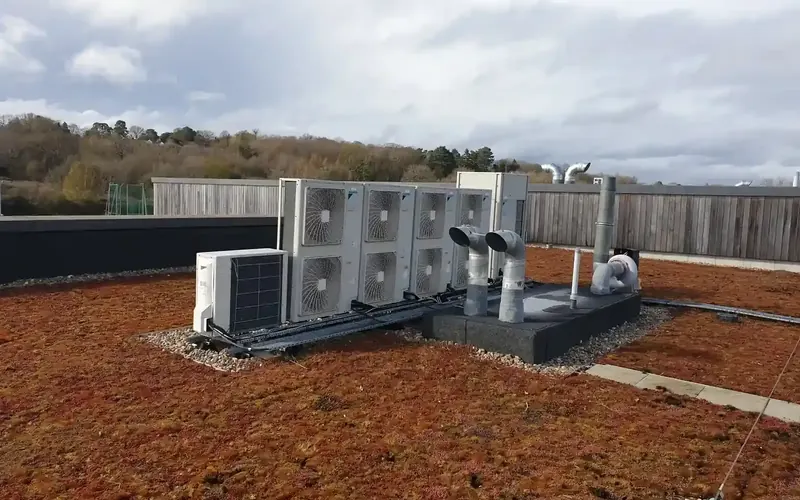
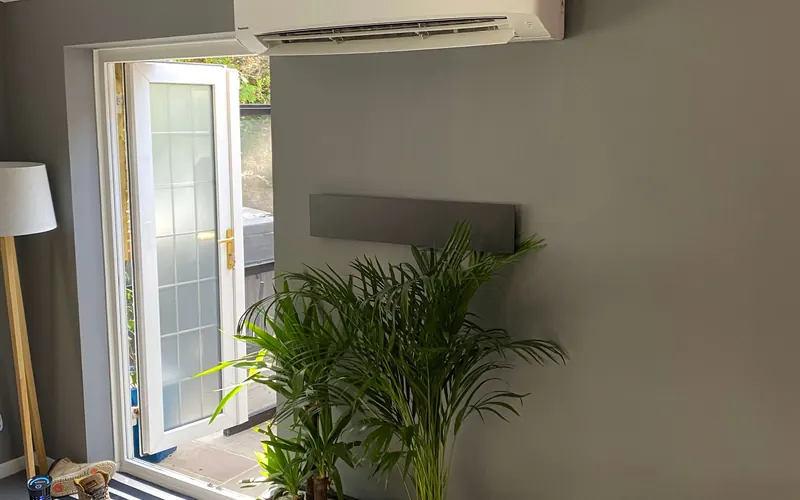
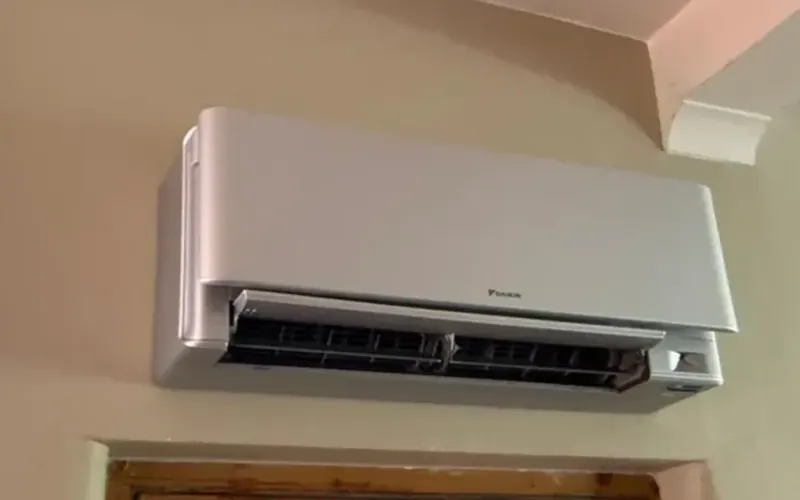
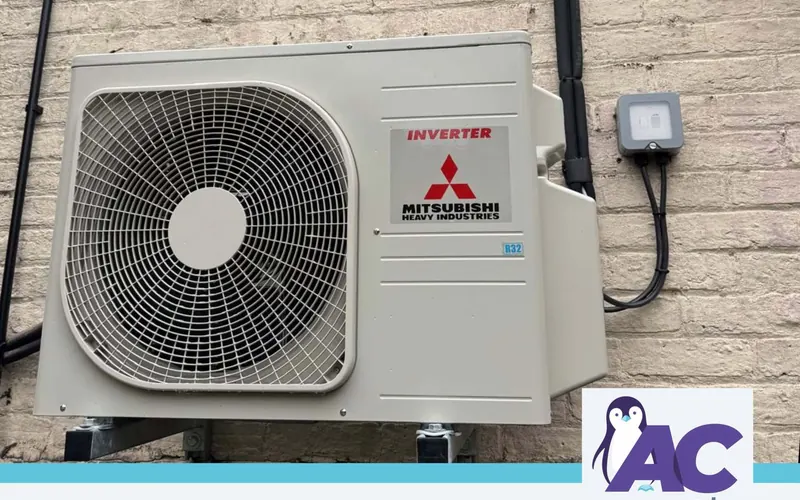
An air-to-air heat pump moves heat between the air outside and the air inside a room. An outdoor unit (the compressor and fan) connects by refrigerant pipes to one or more indoor units, usually mounted high on a wall. Run it one way and it warms the room; reverse the cycle and it cools it.
That is the same hardware sold as air conditioning. The Energy Saving Trust says people often call these systems air conditioning, and Which? says a reversible air conditioning system and an air-to-air heat pump differ very little in theory. Checkatrade describes the heating mode as a reverse cycle.
Two things to watch:
- Some units are cooling only. They cannot heat, so they are not heat pumps and they follow different planning and grant rules.
- Most do not make hot water. The Energy Saving Trust says most air-to-air systems do not provide it, though at least one manufacturer sells a model that heats a hot water cylinder. Which? says some systems can connect to a hot water tank, but not all. The usual answer is that you keep an immersion heater, electric shower or similar.
One outdoor unit can usually serve up to five indoor units (Which?). A "monobloc" variant has no outdoor unit at all; it draws air through two holes of roughly 15 to 20 cm in an external wall, which helps where outside units are not allowed, though it only serves one room.
If you want the equipment explained in more detail, read our split-system air conditioning guide.
Air-to-air vs air-to-water
Air-to-water heat pumps heat water and send it round radiators or underfloor pipes. They replace a boiler. Air-to-air units heat the air directly.
| Air-to-air | Air-to-water | |
|---|---|---|
| What it heats | Room air | Water for radiators, underfloor heating, usually a hot water cylinder |
| Also cools | Yes, if reversible | Only some models |
| Needs radiators or wet pipework | No | Yes |
| Typical UK cost (Energy Saving Trust) | About £1,900 for one room, about £3,700 for a three-bed semi | About £12,000 |
| Hot water | Not usually | Yes, with a cylinder |
| Grant (Boiler Upgrade Scheme) | £2,500, status below | £7,500 |
| Best fit | Flats, small homes, homes with electric heating | Houses with a wet heating system and room for a cylinder |
Both figures come from Energy Saving Trust pages updated in September 2026. The air-to-water price is the typical figure they quote for installation before any grant.
Efficiency: what SCOP tells you
Efficiency for heat pumps is measured as a ratio of heat out to electricity in. A Seasonal Coefficient of Performance (SCOP, also called seasonal performance factor or SPF) averages that ratio across a whole heating season. A seasonal figure of 4 means four units of heat for each unit of electricity. The Energy Saving Trust explains the same idea with the coefficient of performance: a figure of 3.0 gives three units of heat for every unit of electricity used.
Two numbers matter, and they are not the same thing:
- The label SCOP. Manufacturers publish this from standard test conditions. Daikin's Perfera wall-mounted range lists SCOP values from 4.10 up to 5.10 on its product profile.
- The in-use SCOP. This is what your home achieves. It depends on the design, the weather, how you set the controls and how well insulated the building is.
The Energy Saving Trust is open about the gap: it says there is currently not much data on how air-to-air systems perform in UK homes, so it is hard to know how much you would save. For heat pumps in general it says you can get three to four times as much heat as the electricity you use, and that installers must calculate the seasonal figure from the design for your home. We read label values near 5 as the best case for a small unit running in mild weather, not as your bill.
Cooling has its own rating, SEER. The same Daikin profile lists up to 8.65 for its smallest unit.
What an air-to-air heat pump costs in the UK
The Energy Saving Trust's figures, last updated 11 September 2026:
- About £1,900 to heat a single room
- About £3,700 to heat a three-bedroom semi-detached house
They add that other costs, such as redecoration, may apply. Which? repeats the same figures and adds that you may need to budget for removing an existing heating system and for hot water.
Local installer pages we read on 10 October 2026 sit around the same level. Eaglereach says a single-unit residential install starts from around £1,300 fully fitted, and Ernest Air Cooling says Sussex installs start from around £1,899 for a single room, rising to £5,000 and above for multi-room systems. Our air conditioning cost guide sets these against national price guides and explains what moves a quote up or down.
The £2,500 grant: where it stands on 10 October 2026
Air-to-air units were not part of the Boiler Upgrade Scheme until the government announced an expansion in November 2025 (Energy Saving Trust), so any guide that still says they are excluded is out of date. Some newer ones promise a grant that nobody can yet collect. Here is what the primary sources say.
What the rules say
GOV.UK lists £2,500 towards an air-to-air heat pump among the current Boiler Upgrade Scheme grants. Ofgem, which runs the scheme, lists the same amount for residential properties only and says its installer guidance (version 5) applies to applications made on or after 28 April 2026.
The conditions in Ofgem's guidance and GOV.UK's eligibility page:
- You own the property in England or Wales (second homes and rental properties are included).
- The new system replaces an existing fossil fuel or electric heating system. It cannot replace a low-carbon system.
- It cannot be added alongside a gas or oil boiler. Which? points out you cannot use the grant to add an air-to-air heat pump as a second heating and cooling system next to a boiler.
- The heat pump must be sized to meet the whole space heating need. Hot water must also be covered, either by the heat pump or by a permitted supplementary appliance. Ofgem's examples of permitted appliances include immersion heaters and direct electric heating.
- Non-residential buildings are not eligible for air-to-air units.
- The work must be done by an MCS-certified installer, who applies on your behalf. The grant comes off your quote.
- One grant per property.
Why you probably cannot claim it yet
Three sources, all dated this year, say the practical machinery was not ready, and we rechecked on 10 October 2026.
- The ECIU reported on 10 July 2026 (updated 16 July) that, although some applications had been received, no installations had taken place because documentation from MCS and the UK Accreditation Service was still outstanding.
- MCS's own update of 13 April 2026 says it is still working with certification bodies to gain UKAS accreditation to certify air-to-air installers and products. Its consumer page says no installers are yet certified.
- The Energy Saving Trust page, updated 11 September 2026, says grants are not available yet but will be.
Checked 10 October 2026. GOV.UK and Ofgem both still list £2,500 for an air-to-air heat pump. MCS's consumer page still says no installers are yet certified to install air-to-air heat pumps, and its Boiler Upgrade Scheme installer page says air-to-air heat pumps will come into MCS "later this year". We found no GOV.UK, Ofgem or MCS statement that the first funded installation has been completed.
We found no evidence of a certified installer completing a funded air-to-air job. If you read an installer page that promises the £2,500 now, ask for the MCS certificate number and for the voucher approval in writing before you sign. The position may change, so check Ofgem's property owner page and MCS's consumer page before you commit.
Does the 0% VAT relief apply?
Ofgem says there is 0% VAT on installing energy-saving materials, including heat pumps, from 1 April 2022 to 31 March 2027. It does not say whether that covers an air-to-air unit, so ask your installer to confirm in the quote whether VAT is charged.
Is MCS relevant if you skip the grant?
Partly. MCS (the Microgeneration Certification Scheme) is a quality scheme, and it matters in three places:
- The grant. Only MCS-certified installers can claim the Boiler Upgrade Scheme.
- Planning. The permitted development noise calculation for air source heat pumps is an MCS document, MCS 020 a). See our planning guide for Brighton and Hove.
- Competence. In its update of 13 April 2026, MCS says a business's technical supervisor on an air-to-air job must hold refrigeration, air conditioning and heat pump competence at Level 3 or above.
The legal requirement for fitting refrigerant systems is separate: your company and the engineers must hold F gas certification (GOV.UK). Our F gas guide shows how to check.
Running costs against gas
Ofgem's price cap from 1 October to 31 December 2026 is 26.32p per kWh for electricity and 7.97p per kWh for gas (national averages, Direct Debit, before standing charges).
A gas boiler turns about 90% of its fuel into heat, according to the Energy Saving Trust for an A-rated boiler. So a kWh of heat from gas costs about 7.97 ÷ 0.9 = 8.9p. A kWh of heat from a heat pump costs 26.32p divided by its SCOP.
| Heating method | Cost per kWh of heat | Cost per 1,000 kWh of heat |
|---|---|---|
| Gas boiler, 90% efficient | 8.9p | £88.60 |
| Electric heater (direct) | 26.3p | £263.20 |
| Heat pump, SCOP 3 | 8.8p | £87.70 |
| Heat pump, SCOP 4 | 6.6p | £65.80 |
| Heat pump, SCOP 5 | 5.3p | £52.60 |
This is our arithmetic from the Ofgem and Energy Saving Trust figures above. It shows that a SCOP near 3 breaks even with a gas boiler at today's prices, and every point above that saves money. A direct electric heater is four times the cost of a SCOP 4 heat pump, which is why Which? singles out homes on electric heating as the easiest switch.
Two points move the answer:
- Standing charges. The gas standing charge in the cap is 29.68p a day, about £108 a year. You only save that if you remove the gas supply, which means no gas hob or boiler left.
- Tariff. The Energy Saving Trust says that on standard tariffs, where electricity costs nearly four times as much as gas, a heat pump can cost slightly more than a new gas boiler. On a heat pump time-of-use tariff, it can cost less.
For hourly costs, multiply the unit's power draw by the unit price. Daikin's nominal figures for its 2.5 kW class Perfera show 0.56 kW input in both cooling and heating, which is about 15p an hour at 26.32p per kWh. Use the running cost estimator tool to try your own numbers.
Cooling adds to the bill. Which? warns that if you have no air conditioning today, using an air-to-air heat pump to cool will add considerably to your annual energy use, and recommends shading and insulation first.
Pros and cons
What works in its favour, per the Energy Saving Trust and Which?:
- Cheaper to buy than an air-to-water heat pump, and no radiators needed
- Far cheaper to run than direct electric heating
- One system heats and cools
- Outdoor units are typically smaller than air-to-water ones, which suits flats and homes with little outdoor space
What counts against it:
- Indoor units can be noisier than other heat pumps
- Several indoor units mean new pipework, which the Energy Saving Trust says typically runs in a slim plastic channel around the upper edges of the room
- It recirculates room air, so you still ventilate the home
- Hot water is separate
- Real UK performance data is thin, so savings are harder to predict
Who it suits
A reversible air conditioner makes the most sense when:
- You heat with electric panels or storage heaters. The saving is large and the install is simple.
- You live in a flat or small house. One or two indoor units can cover the rooms you use most.
- A room overheats in summer. You get cooling and winter heat from one purchase.
- You have no wet heating system. Installing radiators is the expensive step an air-to-air system avoids.
It suits you less when:
- You have an efficient gas boiler and radiators that work. The saving against gas is modest unless the SCOP is high.
- The house is large, draughty or poorly insulated. Many indoor units, long pipe runs and high heat loss mean the economics shift towards an air-to-water system.
- You need whole-house hot water from the same machine.
In Brighton and Hove, that translates to flats and small terraces where one or two rooms matter most, and where the planning and lease points in our other guides apply.
Planning and F gas
In England, an air-to-air unit that provides heating can fall under the air source heat pump permitted development class, as long as it meets size, position and noise limits. A cooling-only unit does not. Conservation areas, listed buildings and flats have tighter rules. The full rules are in our Brighton and Hove planning guide.
Whoever fits the system must be F gas certified. Ask to see it.
Next steps
- Decide what you want the system to do: heat, cool, or both, and in which rooms.
- Ask for the design SCOP in writing, with the assumptions behind it.
- Ask whether the quote includes VAT and what happens to the £2,500 if the grant is not available when you want to proceed.
- Get at least three quotes. The Energy Saving Trust recommends at least three, from MCS-certified installers where the grant applies.
- Use the size calculator to sanity-check the kW each installer proposes.
Questions
Is it better to have a heat pump or an air conditioner?
Can you use a heat pump as an air conditioner?
Are heat pumps air-to-air?
Is there a grant for air-to-air heat pumps?
What is the downside of having a heat pump?
Are heat pumps noisy?
How much does it cost to run a heat pump for 1 hour?
Do air-to-air heat pumps need planning permission?
Why is my electric bill so high with an air source heat pump?
Sources
- Energy Saving Trust: Air-to-air heat pumps (last updated 11 Sep 2026)
- Energy Saving Trust: Air source heat pumps, costs, savings and benefits (updated 23 Sep 2026)
- Energy Saving Trust: Heat pumps, how they work, costs and savings
- Which?: Using air-to-air heat pumps for air conditioning (17 Jul 2026)
- GOV.UK: Apply for the Boiler Upgrade Scheme
- Ofgem: Boiler Upgrade Scheme, guidance for property owners
- Ofgem: Boiler Upgrade Scheme installer guidance V5 (28 Apr 2026)
- MCS: Air-to-air heat pumps (consumer page)
- MCS: Update on the implementation of air-to-air heat pumps into MCS (13 Apr 2026)
- ECIU: Free government grants for air con going largely unclaimed (10 Jul 2026, updated 16 Jul 2026)
- Ofgem: Energy price cap unit rates and standing charges, 1 Oct to 31 Dec 2026
- Daikin UK: Perfera wall mounted unit product profile (FTXM-R)
- Ofgem: Boiler Upgrade Scheme (grant amounts)
- MCS: Boiler Upgrade Scheme, installer page
- Checkatrade: Air conditioning in Brighton, FAQs (read 10 Oct 2026)
- Planning Portal: Planning permission for an air source heat pump
- GOV.UK: Company certification to work with F gas
Written and checked by Alex Christou. Found a mistake? Tell us; our corrections policy explains what happens next.