On this page
Quick answer. A split-system air conditioner has an outdoor unit and one or more indoor units joined by refrigerant pipes. One indoor unit is a single split; up to five on one outdoor unit is a multi-split. A single split costs about £1,800 to £3,500 installed, takes four to six hours, and needs F gas certified engineers.
What a split system is
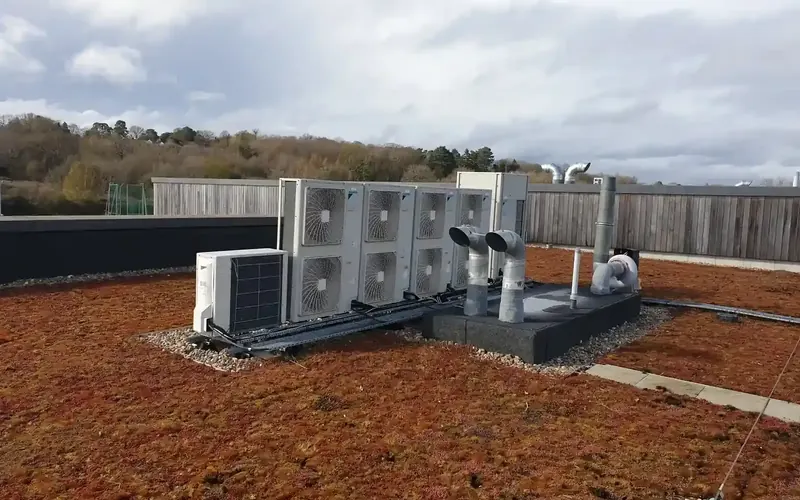
"Split" means the system is split into two parts. The outdoor unit holds the compressor and fan and sits on a wall, the ground or a flat roof. The indoor unit hangs in the room. Refrigerant pipes (Which? calls them coolant lines) connect the two. The installation also needs a power supply and a way to drain the condensation.
In cooling mode the indoor unit takes heat out of the room air and the outdoor unit releases it outside. Which? says this makes split units quieter and usually more efficient than portable models, with no need to leave a window open for a hose. The trade-off is that the installation is more involved: the units are fixed in place, and the outdoor unit and pipework mean drilling through an external wall.
Many split units are reversible, and Checkatrade describes the heating mode as the same cycle run backwards. That makes them air-to-air heat pumps. Our air-to-air heat pump guide covers running costs against gas and the grant position.
Ductless mini-split is the same thing
Some sites use "ductless" or "ductless mini-split" for the same equipment, meaning there is no ductwork. Which? uses "mini-split" for a system with several indoor units on one outdoor unit. In listings, "split", "mini-split" and "wall-mounted split" overlap. What matters is the number and type of indoor units.
Single split vs multi-split
| Single split | Multi-split | |
|---|---|---|
| Indoor units | One | Two to five on one outdoor unit (Which?) |
| Outdoor units | One per indoor unit | One in total |
| Installed price | £1,800 to £3,500 (Trade2Base, Heatable) | £3,200 to £5,500 for two rooms; £4,500 to £7,500 for three (Trade2Base) |
| Extra cost per added room | Another complete system | About £800 to £1,200 (Heatable) |
| Best for | One room that overheats | Two to five rooms, or a home where several outdoor units would clutter the wall |
| Installation time | Four to six hours (Trade2Base) | Add two to three hours per extra indoor unit (Trade2Base) |
A multi-split needs one outdoor unit rather than several, which helps where wall space or planning is tight. It also means all the rooms share one outdoor unit's capacity, so ask the installer how the outdoor unit is sized for the rooms you will run at the same time.
Equipment prices from Trade2Base for context: a single split indoor unit £300 to £800 and outdoor unit £400 to £1,200; a multi-split outdoor unit £800 to £2,500, with each extra indoor unit adding £250 to £600 in equipment. The rest of an installed price is labour, pipework and commissioning. Our cost guide has a full table with sources and dates.
Indoor unit types
| Type | What it is | Typical installed cost | Suits |
|---|---|---|---|
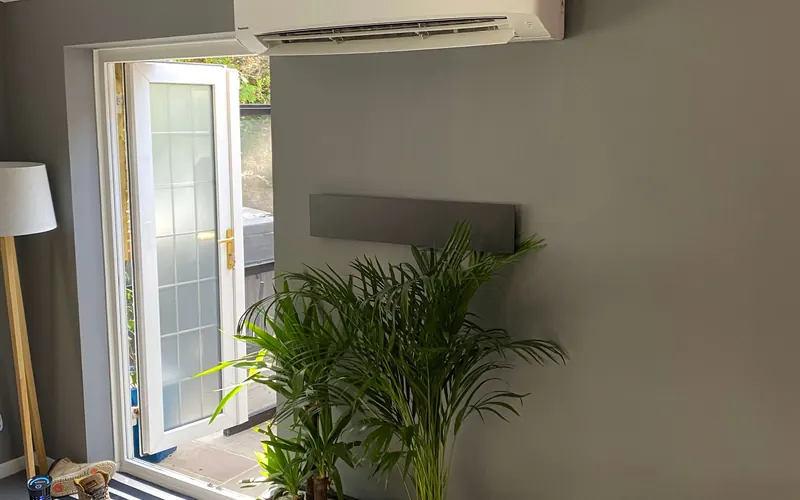
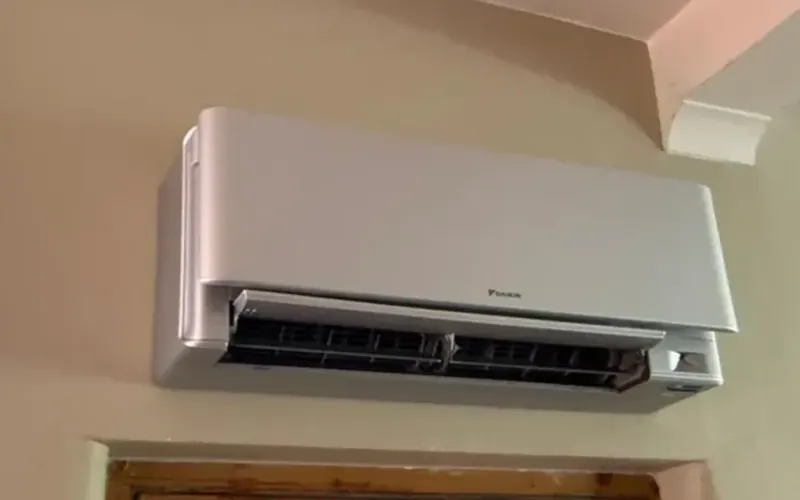
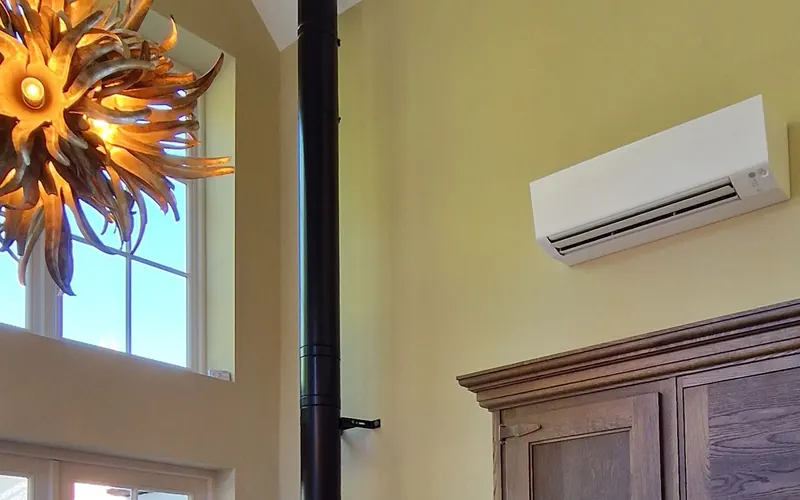
| Wall-mounted | Slim unit high on a wall | £1,800 to £3,500 for a single split | Bedrooms, lounges, home offices |
| Floor-standing | Low unit near the skirting | Ask for a quote; Which? lists it as an option | Rooms with no free wall space above head height |
| Concealed | Hidden in the wall or ceiling (Which?) | Ask for a quote | Rooms where the look matters |
| Ceiling cassette | Square unit set flush in a ceiling | £1,500 to £2,800 per unit (Trade2Base) | Open-plan rooms, offices, shops |
| Ducted | One central unit, ducts and grilles | £5,000 to £10,000+ (Heatable) | Whole homes, ideally during renovation |
Wall-mounted is the usual starting point. Ducted systems, in Which?'s words, can be disruptive to install unless you already have ducted warm air heating, which is uncommon in the UK. Heatable notes ducted work is labour-intensive, especially in a finished home.
Which? also mentions a monobloc type that has no outdoor unit and uses two holes in the wall. It serves one room only, but it can help where an external unit is not allowed.
Split system vs portable
| Split | Portable | |
|---|---|---|
| Cost | Upwards of £500 for the unit, plus installation (Which?) | £300 to £1,000 (Heatable) |
| Installation | Permanent, by a certified professional | None; a hose goes through a window |
| Efficiency | Usually better (Which?) | Not as efficient (Which?) |
| Noise | Quieter indoors | Compressor is in the room |
| Running cost | Checkatrade: 20p to 40p an hour | Which? tests: 22p an hour on average at highest setting, range 17p to 31p |
| Movable | No | Yes |
| Renters | Needs landlord permission | Often the practical choice |
The running-cost rows come from different sources with different methods, so do not read them as a head-to-head test. Which? says portables use about as much energy in a day as a typical fridge freezer and says it does not test split units.
If you rent, Checkatrade says permanent installations such as wall-mounted or ducted systems usually need your landlord's permission.
Sizing: how many kW do you need?
Split systems are sold by capacity in kW (some sites use BTU; one kW is roughly 3,412 BTU per hour, a standard conversion). Daikin's Perfera wall-mounted range spans 2.0 kW to 7.1 kW nominal cooling. Which? makes the point for portables that a unit with too low a capacity for the room works harder and uses more electricity, and the same logic applies to a split.
A quick estimate
Daikin UK's size guide gives a rule of thumb of about 0.1 kW of cooling per square metre of floor, for average ceilings and insulation. Its reference table puts a 20 m² bedroom at about 2 kW, a 35 m² living room at about 3.5 kW and a 40 m² open lounge and kitchen at about 4 kW.
A 4 m × 3 m bedroom is 12 m², so the rule gives about 1.2 kW. That is below the smallest split systems on sale (Daikin's Perfera range starts at 2.0 kW), which is why Heatable says a small bedroom often suits a 2.5 kW unit. Daikin adds about 20% for the South East of England compared with Scotland. Treat the rule as a floor, not a recommendation. It ignores the things that make a room hard to cool.
What a proper survey adds
Heatable lists the factors that change the answer: room size, insulation, ceiling height, glazing, sun exposure and the position of the outdoor unit. Daikin also lists window orientation among the factors, so as a general rule a sunny top-floor room will need more output than the same floor area in a shaded basement. Heatable suggests a small bedroom often suits a 2.5 kW unit and says a larger lounge may need 5 kW or more.
Use the size calculator to get a starting range, then ask each installer for the load they calculated and why. If one quote proposes a unit twice the size of the others, ask why.
How noisy is it?
Two noise figures matter: the indoor unit next to you and the outdoor unit next to the neighbours.
From Daikin's Perfera product profile, across its range:
| Unit | Setting | Sound pressure |
|---|---|---|
| Indoor, cooling | Silent / low / high | 19 / 25 / 41 dBA (smallest) up to 32 / 38 / 47 dBA (larger models) |
| Outdoor, cooling | Nominal | 46 to 49 dBA |
Those figures come from the manufacturer's test conditions; a bedroom wall, bed position and ambient noise change what you hear. The Energy Saving Trust warns that indoor units of air-to-air systems can be noisier than other heat pumps, so ask for the sound level at the setting you will use at night.
Outdoor noise also matters legally. If you rely on permitted development for planning, the unit must pass the MCS 020 a) calculation: no more than 37 dB at a point 1 metre outside a neighbour's door or window of a habitable room. See the planning guide for Brighton and Hove.
How installation works
A typical single-split job, based on the Trade2Base and Heatable descriptions:
- Survey. The installer checks the room, wall type, electrics, outdoor unit location and access, then quotes. A site survey is how you find out about extras before they appear on the invoice.
- Permissions. Planning, lease consent or listed building consent if needed, before work starts.
- Mount the indoor unit. A wall bracket is fixed, usually high on the wall.
- Core the wall. A hole is drilled through for pipes, cable and drain.
- Fix the outdoor unit on brackets or a stand.
- Run the pipework and cable, insulate it and cover it in trunking. Daikin allows 10 m of pipe on its Perfera units with no extra refrigerant, then 0.02 kg per metre beyond that, up to 20 or 30 m depending on model.
- Connect the power. Heatable puts extra electrical work at £200 to £1,000 when the supply needs altering.
- Test the pipework for leaks and check the gas pressure.
- Commission the unit, check temperatures and the drain, and show you the controls.
- Record the work. Trade2Base says F gas records must be completed before a job counts as finished.
Trade2Base says a two-person team usually takes four to six hours for a single split, and adds two to three hours for each additional indoor unit on a multi-split. Checkatrade says larger homes with multi-split or ducted systems can take one to three days.
F gas: the legal requirement
Split systems contain fluorinated gas (F gas). GOV.UK says your company, including sole traders, must be certified by an approved body to install, repair, maintain or decommission air conditioning. Certification bodies for stationary air conditioning listed on the page include Refcom, the F-Gas Register (Quidos) and Bureau Veritas.
Each engineer also needs their own qualification. GOV.UK sets out categories: category 1 for all activities, category 2 for installing, servicing and recovering refrigerant from systems with less than 3 kg of F gas (less than 6 kg if hermetically sealed). It is against the law to work with F gas without the right qualifications and certification, and the penalty can be a civil sanction.
Refrigerant matters for the future too. R32, now common in new splits, has a global warming potential of 675, against 2,088 for R410A (GOV.UK). The UK is phasing down HFCs by 79% by 2030 against the 2009 to 2012 average. Daikin lists R32 charges of 0.76 to 1.15 kg for its Perfera outdoor units. Our F gas guide shows how to check an installer on the public registers.
Planning permission
A reversible split on a house in England is often permitted development, but a cooling-only unit needs a planning application, and conservation areas, listed buildings and flats have extra rules. The Planning Portal's FAQ says the permitted development rights only apply if the system provides a heating function. Read our Brighton and Hove planning guide before you order.
Running and care
- Running cost. Multiply the unit's power input in kW by the electricity price. At the October to December 2026 cap of 26.32p per kWh, Daikin's 2.5 kW class unit (0.56 kW nominal input) costs about 15p an hour. Use the running cost estimator tool for your own case.
- Filters. Daikin's units have a removable, washable air filter. Clean it as the manual says.
- The three-minute wait. Do not restart immediately after switching off; Checkatrade says to wait at least three minutes to protect the compressor.
- Servicing. Checkatrade says air conditioning needs regular servicing. Published prices are in our cost guide.
Choosing a split system
- Decide the rooms and whether you want heating as well as cooling.
- Size each room properly rather than guessing.
- Choose single or multi-split based on how many rooms and where the outdoor unit can go.
- Check the noise at night-time settings and for the neighbours.
- Get three quotes from F gas certified installers, itemised the same way.
Questions
What is a split system air conditioner?
What is the difference between single split and multi-split?
Is a split system better than a portable air conditioner?
How long does it take to install a split system?
What size split system do I need for a bedroom?
Do I need an F gas engineer to install air conditioning?
How noisy is a split system?
Can a split system heat my home as well?
What is the 3 minute rule for air conditioners?
Sources
- Which?: Air conditioners, portable vs split-unit, how they work (26 Aug 2026)
- Daikin UK: Air conditioner size guide
- Which?: Using air-to-air heat pumps for air conditioning (17 Jul 2026)
- Heatable: Air conditioning installation costs UK (updated 7 Oct 2026)
- Trade2Base: How to price air conditioning installation in the UK (1 Jul 2026)
- Checkatrade: Air conditioning in Brighton, FAQs and cost estimates (read 10 Oct 2026)
- Daikin UK: Perfera wall mounted unit product profile (FTXM-R)
- Energy Saving Trust: Air-to-air heat pumps (updated 11 Sep 2026)
- GOV.UK: Company certification to work with F gas
- GOV.UK: Qualifications to work with F gas (updated 3 Mar 2026)
- GOV.UK: Fluorinated gases (F gases), global warming potentials and HFC phase-down
- GOV.UK: Checking F gas equipment for leaks
- Planning Portal: Do I need planning permission to add air conditioning to my home?
- MCS 020 a): Air Source Heat Pump Sound Calculation for Permitted Development Installations, Issue 1.1
- Ofgem: Energy price cap unit rates and standing charges, 1 Oct to 31 Dec 2026
Written and checked by Alex Christou. Found a mistake? Tell us; our corrections policy explains what happens next.