On this page
Quick answer: Cost is electrical input (kW) x hours x unit rate. At Ofgem's 26.32p per kWh, a 3.5 kW split costs about 10p to 20p an hour to cool a room and a portable about 30p to 35p. A split running 350 full-output hours a year costs roughly £35 to £53.
Prices checked 10 October 2026. The sum is simple. The part that trips people up is converting "3.5 kW of cooling" into the electricity used, so we do it step by step.
The sum: kW x hours x unit rate
Air conditioners are sold by the heat they move (output), but you pay for the electricity they draw (input). Efficiency links the two.
Electrical input (kW) = cooling output (kW) ÷ efficiency Cost = electrical input (kW) × hours × unit rate (£ per kWh)
Worked example for a 3.5 kW cooling output at an efficiency of 6.1, at 26.32p per kWh:
- Input = 3.5 ÷ 6.1 = 0.57 kW
- Cost per hour = 0.57 kW × 26.32p = about 15p
- Over 350 hours = about £53
Use the running cost estimator to run your own figures. It takes the same three inputs.
Which unit rate to use
Ofgem's price cap for 1 October to 31 December 2026 sets average rates for people paying by Direct Debit in England, Scotland and Wales:
| Unit rate | Standing charge | |
|---|---|---|
| Electricity | 26.32p per kWh | 54.83p a day |
| Gas | 7.97p per kWh (includes 5% VAT) | 29.68p a day |
Ofgem says there is no VAT on electricity from 1 October 2026 to 31 March 2027, and that it sets the price cap level every three months (Ofgem's price cap explainer), so these rates cover 1 October to 31 December 2026 only. Your own rate depends on your region, payment method and tariff, and a fixed deal can sit above or below the cap. Check your bill. Which? uses the same 26.32p figure for its running-cost estimates. Standing charges do not change when you add an air conditioner, so we leave them out of every example below.
What the efficiency numbers mean
Three figures appear on datasheets, and mixing them up is the commonest mistake.
| Figure | Stands for | Use it for |
|---|---|---|
| EER | Energy efficiency ratio at one full-load test point | Quick full-load cost per hour |
| SEER | Seasonal energy efficiency ratio, cooling | A realistic season average, bearing in mind part-load running |
| SCOP | Seasonal coefficient of performance, heating | Heating cost over a season |
UK law (retained Regulation 626/2011) sets the label classes for air conditioners up to 12 kW. A+++ starts at SEER 8.50, A++ at 6.10, A+ at 5.60, A at 5.10 and B at 4.60. For heating, A+++ starts at SCOP 5.10, A++ at 4.60, A+ at 4.00, A at 3.40 and B at 3.10. The label assumes 350 hours of cooling and 1,400 hours of heating in an average climate year, which is how it produces its "kWh per year" figure.
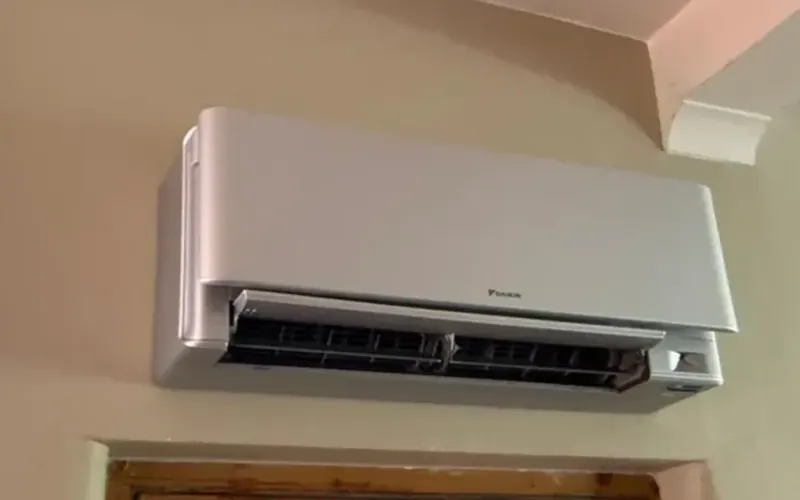
Efficiency is not constant, which is why seasonal figures are higher than full-load ones. The certified Daikin RXM35A/FTXM35A has an EER of 4.63 at full 3.5 kW output. At lower outputs the certified figures are higher: EER 7.23 at 2.58 kW, 11.51 at 1.66 kW and 14.30 at 1.25 kW. (These are the certificate's part-load points. The record does not give the outdoor temperature for each, so we do not split the gain between lower load and other test conditions.) Its SEER is 9.25 and its SCOP is 5.20. Daikin UK's size guide gives about 0.1 kW per square metre as a rule of thumb for choosing the capacity, and the size calculator helps with a first estimate.
Cooling cost: split systems and portables
All figures below are for a 3.5 kW cooling output at 26.32p per kWh. Efficiency inputs come from the legal class boundaries and the certified Daikin record, which we picked as a named, checkable example. The class-boundary rows show what the lowest unit in each class would cost.
| Unit | Efficiency used | Input | Cost per hour |
|---|---|---|---|
| Split, A+++ (Daikin FTXM35A, seasonal) | SEER 9.25 | 0.38 kW | about 10p |
| Split, bottom of A++ (seasonal) | SEER 6.1 | 0.57 kW | about 15p |
| Split, bottom of A (seasonal) | SEER 5.1 | 0.69 kW | about 18p |
| Split, certified, full load | EER 4.63 | 0.76 kW | about 20p |
| Portable, class A, full load | EER 3.1 to 2.6 | 1.13 to 1.35 kW | about 30p to 35p |
| Portable, class D, full load | EER 2.1 to 1.8 | 1.67 to 1.94 kW | about 44p to 51p |
The last two rows use the EER bands for portable (single and double duct) units in Annex II. Compare the "full load" rows with each other and the "seasonal" rows with each other. A seasonal figure is flattering because it includes gentle part-load running, so on a very hot day, when the unit works hard, expect closer to the full-load rows. The like-for-like gap is about 20p against 30p to 35p an hour, which is one and a half to nearly two times as much for the class A portable. One more caveat: Annex VII tests splits and double-duct portables with 27 °C air indoors, but single-duct portables with 35 °C indoors, a tougher test. The 35 °C condition applies only to single-duct units, so the like-for-like gap may be smaller than the table suggests for a single-duct portable, and it is not a rule for every portable.
Which? sells the same message in a different form. It says most portable units need hose venting, that a window left partly open lowers efficiency, and that portable units are heavy and awkward. Its own running-cost column for tested models sits behind its paywall, so we do not quote it.
From hours to a yearly bill
"Hours" here means hours at full cooling output. A unit rarely works flat out for a whole clock hour, so use the label's 350 hours as a standard year, 100 as a light user and 700 as a heavy one.
| Hours of full-output cooling a year | Split, SEER 9.25 | Split, SEER 6.1 | Portable, class A floor (EER 2.6) |
|---|---|---|---|
| 100 | £10 | £15 | £35 |
| 350 | £35 | £53 | £124 |
| 700 | £70 | £106 | £248 |
Against the £1,723 a year that Ofgem quotes for the 1 October to 31 December 2026 price cap, 350 hours on an efficient split adds about 2 to 3%. Homebuilding quotes a Daikin representative at about £900 a year for a five-room multi-split used for both heating and cooling six hours a day, seven days a week, and about £600 at four hours a day in a well-insulated house. Homebuilding does not state the unit rate behind them, and they cover a whole season of heating as well, so treat them as the scale of a whole-house system rather than a summer cooling bill.
Heating cost: heat pump against gas
A reversible split is an air-to-air heat pump, and Which? says it is far more efficient than direct electric heating. Heating cost uses SCOP, and the price comparison with gas is where the electric rate matters. Gas is cheaper per kWh, but a boiler delivers less than 1 kWh of heat per kWh of gas, and a heat pump delivers several.
For 4 kW of heat output at 26.32p per kWh electricity and 7.97p per kWh gas:
| Heat source | Efficiency | Cost per kWh of heat | Cost per hour (4 kW) |
|---|---|---|---|
| Heat pump, A+++ (Daikin FTXM35A) | SCOP 5.2 | 5.1p | about 20p |
| Heat pump | SCOP 4.0 | 6.6p | about 26p |
| Heat pump, bottom of class A | SCOP 3.4 | 7.7p | about 31p |
| Heat pump | SCOP 3.0 | 8.8p | about 35p |
| Gas boiler (assumed 90%) | 0.90 | 8.9p | about 35p |
| Gas boiler (assumed 80%) | 0.80 | 10.0p | about 40p |
| Direct electric heater | 1.0 | 26.3p | about £1.05 |
The 90% figure is the Energy Saving Trust's for an A-rated boiler. The 80% figure is our own assumption for an older boiler, not a sourced figure. Swap in your own boiler's seasonal efficiency. Put the break-even in a sentence: at those rates a heat pump matches gas on fuel cost at a SCOP of about 3.0 for a 90% boiler and about 2.6 for an 80% one. The certified Daikin record also lists a COP of 3.15 at -10 °C outdoor temperature, so even in a hard cold snap that unit stays above the 90% boiler break-even. This ignores standing charges, the cost of fitting the unit, and the fact that SCOP is a laboratory seasonal figure and not a guarantee for your house.
Which? also warns that if you have never had air conditioning, using a heat pump for cooling will add considerably to your annual energy use, and recommends insulation and shading first. Both cost nothing to run once they are in place.
How to cut the cost
- Size it right. Daikin warns that wrong sizing risks a more expensive unit, higher running costs and reduced comfort. Daikin adds about 20% for the South East of England against Scotland.
- Clean the filters. Daikin and Samsung UK both recommend cleaning about every two weeks. Toshiba's maintenance guidance lists keeping energy efficiency up and operating costs down among the reasons for regular servicing, and says airflow should not fall below 80% of the specified value.
- Pay for efficiency where you will use it. On the figures above, going from SEER 6.1 to 9.25 saves about £18 a year at 350 cooling hours. If the unit also heats for months, higher SCOP saves more.
- Use the schedule. Which? says air-to-air units are programmable, and many offer smart control.
- Close the room up. Which? notes that a window left partly open makes a portable unit less energy-efficient. Keep windows closed while cooling.
- Cool the building as well as the air. Shading and insulation first, as Which? advises.
Our servicing guide covers what a yearly service costs, and our guide to choosing a home system covers efficiency classes in more detail. To compare installers who show prices and efficiency ratings, start at our Brighton and Hove installer directory.
Questions
How much does it cost to run an aircon for 1 hour?
Is it cheaper to run AC all day or turn it off?
Is AC expensive to run in the UK?
How much does it cost to run a heat pump for 1 hour?
Is a portable air conditioner cheaper to run than a split system?
What does SEER mean on an air conditioner?
Does air conditioning use more electricity than a fan?
Can air conditioning heat my home as well?
Sources
- Ofgem: Energy price cap unit rates and standing charges, 1 October to 31 December 2026
- Which?: Best portable air conditioners (running costs calculated at 26.32p/kWh, October 2026 cap)
- Which?: Should you buy an air conditioner or an electric fan this summer? (17 August 2026)
- Which?: How a heat pump can cool your home
- Eurovent certified performance: Daikin RXM35A / FTXM35A (EER, SEER, SCOP, part-load figures)
- Ofgem: Energy price cap explained (cap set every 3 months)
- Energy Saving Trust: Heat pumps, how they work, costs and savings (A-rated boiler converts 90% of fuel into heat)
- Regulation 626/2011, Annex II: energy efficiency classes (SEER, SCOP, EER)
- Regulation 626/2011, Annex VII: operating hours used for the label (350 h cooling, 1,400 h heating)
- Regulation 626/2011, Article 1: scope (air conditioners up to 12 kW)
- Daikin UK: air conditioner size guide
- Daikin: air conditioner maintenance tips (clean the filter every two weeks)
- Samsung UK: how to clean air conditioner filters
- Toshiba Air Conditioning UK: warranty guidelines 2025 (benefits of regular maintenance, page 17)
- Homebuilding: Air conditioning cost (running cost estimates from industry sources)
Written and checked by Alex Christou. Found a mistake? Tell us; our corrections policy explains what happens next.