On this page
Quick answer: For most UK homes the best choice is a fixed R32 split system, sized to the room's heat load, with a seasonal efficiency (SEER) of about 6 or higher, fitted by an F-gas certified installer who puts the warranty in writing. Portable units suit renters and one hot room. They are a poor whole-home answer.
Last checked 10 October 2026. The figures below come from the sources listed at the end, which we read on or shortly before that date.
How to choose home air conditioning, step by step
Most buyers start with a brand. Start with the room instead, because a well-sized unit from any approved installer network beats a badge on the wrong size of kit.
1. Pick the type
| Type | Suits | Watch for |
|---|---|---|
| Single split (one indoor, one outdoor unit) | One room, often a bedroom or living room | One outdoor unit per room, so wall space matters |
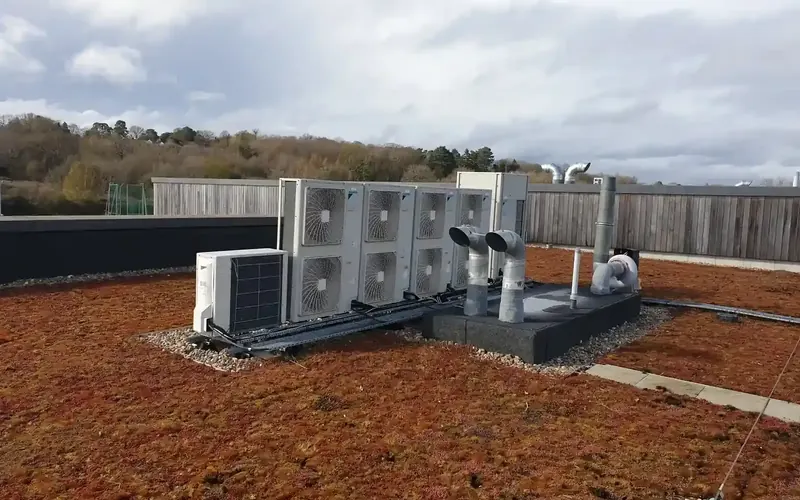
| Multi-split | A flat or small house: one outdoor unit serves up to five indoor units, according to Which? | Pipework runs to each room; the outdoor unit must suit all of them |
| Ducted | Whole-home cooling where a loft or ceiling void exists | Which? calls it disruptive to fit unless you already have ducted warm-air heating |
| Monobloc wall unit | A single room where outdoor units are not allowed | Which? notes it only heats and cools one room |
| Portable | Renters, a short heatwave, a room you cannot drill | Louder, less efficient, hose and window kit needed |
Many homeowners also want heating. A reversible split is an air-to-air heat pump that can do both, and Which? describes the two as the same technology. If heating matters, ask for the SCOP figure as well as SEER.
2. Size it in kW, not in headline BTU
Daikin UK's size guide gives a rule of thumb of about 0.1 kW per square metre for average ceilings and insulation. Its quick reference table:
| Room | Floor area | Typical capacity |
|---|---|---|
| Small bedroom | 20 m² | about 2 kW |
| Living room | 35 m² | about 3.5 kW |
| Open lounge and kitchen | 40 m² | about 4 kW |
Then adjust. Daikin says kitchens often need 10 to 20% more, a 3 m ceiling adds about 25% to room volume, and each person beyond two adds around 0.18 kW. It also notes a 30 m² room that needs 3 kW in Scotland could need 3.6 kW in the South East of England, a 20% rise. Brighton and Hove sits in that South East bracket. Daikin also lists insulation, window orientation and occupancy among the factors, so a sunny top-floor flat needs more than a shaded ground-floor one.
Getting the size wrong in either direction costs money: Daikin warns that skipping the space assessment risks a more expensive unit, higher running costs and reduced comfort. Use the size calculator for a first estimate, then ask the installer for a survey that accounts for your windows and ceiling.
3. Read SEER and SCOP properly
SEER is the seasonal efficiency of cooling and SCOP is the same for heating. Higher is better. UK law (retained Regulation 626/2011) sets the label classes for units up to 12 kW:
| Class | SEER (cooling) | SCOP (heating) |
|---|---|---|
| A+++ | 8.50 or more | 5.10 or more |
| A++ | 6.10 to 8.49 | 4.60 to 5.09 |
| A+ | 5.60 to 6.09 | 4.00 to 4.59 |
| A | 5.10 to 5.59 | 3.40 to 3.99 |
| B | 4.60 to 5.09 | 3.10 to 3.39 |
The label's yearly energy figure assumes 350 hours of cooling and 1,400 hours of heating in an average climate (Annex VII). A real example: the Daikin RXM35A/FTXM35A pair has a certified SEER of 9.25 and SCOP of 5.20 on the Eurovent register, with a 3.5 kW cooling capacity.
Brochures rarely turn this into pounds, so we will. At 26.32p per kWh (the Ofgem cap from 1 October 2026), that Daikin's 350 label hours of cooling use about 132 kWh, or roughly £35 a year. A unit at the bottom of A++ (SEER 6.1) would use about 201 kWh, roughly £53. The gap is about £18 a year for cooling. Heating is where efficiency pays more: on the same record, SCOP 5.20 against SCOP 4.00 is 673 kWh against 875 kWh over 1,400 label hours, about £53 a year. Both figures assume the certificate's design heating load of 2.5 kW (2.5 ÷ 4.00 × 1,400 = 875 kWh), so a larger load scales them up. If you only want summer cooling for a bedroom, do not pay a large premium for the top SEER. If the unit will also heat, do.
Work through your own numbers with the running cost estimator.
4. Check noise in the right unit
Datasheets quote two different things. Sound pressure is what you hear at a set distance, and sound power is what the unit emits. The UK energy label shows sound power in dB(A), per Annex III. The certified Daikin record above lists sound power levels of 58 dB(A) for both the indoor and outdoor unit in cooling. That number is not comparable with a sound pressure figure quoted at 1 m on a brochure, which will look much lower. Compare like with like, and ask for the indoor unit's sound pressure on its quietest setting if the unit goes in a bedroom. We did not find a UK government threshold for bedroom noise, so we do not quote one.
5. Choose R32, and know why
R32 is the refrigerant in most new residential splits. Its global warming potential is 675, against 2,088 for R410A (gov.uk and Daikin both give these figures). Since 2025, gov.uk says new single split systems containing under 3 kg of refrigerant must use gas with a GWP of 750 or less, which rules out R410A for most new single splits. R32 is classed A2L, meaning mildly flammable, and under UK health and safety law it is still treated as flammable (Cooling Post), so installers should be trained to handle it. That is one more reason to use an installer with proven F-gas credentials. See our F-gas register check guide.
6. Smart controls
Which? says air-to-air heat pumps are programmable and often come with a remote and a smart Wi-Fi option, and that many also offer dehumidification and air purification functions. A schedule is handy for cooling a bedroom before you go to bed and switching off at a set time. Check the app works with your phone, and that the unit still has a plain remote for when the Wi-Fi drops.
7. Warranty, and who fits it
This is where brand and installer meet, and it is the least understood part of buying. Manufacturers publish different terms, and for air conditioning several publish them only for installers. In most cases the long warranty depends on the installer's partner tier, on the unit being registered, and on regular servicing.
Manufacturer warranty terms in the UK, by brand
We read each manufacturer's UK pages on 10 October 2026. "Not published" means we opened the pages listed in our sources and found no UK warranty terms for residential air conditioning. That is an absence on the pages we read, not proof that no terms exist. Terms change, so ask the installer for the current wording in your quote.
| Brand | Installer network (named by the manufacturer) | What the UK pages say about warranty |
|---|---|---|
| Daikin | D1 and D1+ Partners, Certified Installers | Residential customers get a two-year guarantee as standard (installer must register it within 90 days). The extended homeowner scheme on the page covers air-to-water heat pumps and says a warranty is only valid if annual maintenance is carried out. For split air conditioning the installer-side page says D1 and D1+ partners get "up to 7 years" and Certified Installers "up to 5 years" on AC equipment, described as commercial warranties |
| Mitsubishi Electric | Accredited Installer, Business Solutions Partner, Diamond Quality Partner | The installer programme lists up to 5, 7 and 10 years by tier. The published homeowner guarantee covers Ecodan heat pumps only |
| Fujitsu | No installer scheme or finder on the pages we read | Not published |
| Toshiba | Standard, Extended and Premium Warranty Partners | 5, 7 and 10 years by tier, "subject to maintenance and application guidelines". The installer must be F-gas registered and show evidence of service and maintenance, with training for the longer tiers. The warranty is conditional on the equipment being regularly maintained by an F-gas registered competent person, and Toshiba says maintenance will typically be biannual. Written for installers |
| LG | No installer finder on the pages we read | Single and multi-split: 3 years basic, 5 years extended if the installer has attended LG training and holds a valid F-gas certificate. The page says units "must be serviced biannually"; single splits also carry a 10-year compressor part-only warranty |
| Samsung | None found on the pages we read | Not published for air conditioners |
| Panasonic | Installer, Accredited Installer, PRO Partner, Elite PRO Partner | 3 years as standard, 5 years for an Accredited Installer and 7 years for a PRO Partner or Elite PRO Partner, in the December 2021 key-facts sheet, with registration within 30 days and annual maintenance records. It is the newest version we found |
| Hitachi | "Where to buy" page for installers and distributors | None on the pages we read. The UK site says Bosch Home Comfort Group is a trademark licensee of Hitachi and sells its products |
| Midea | Not found | The UK warranty page covers home appliances and does not mention air conditioners |
Two things stand out. First, the longest numbers (7 and 10 years) belong to installers who have earned a partner tier, so "what tier is my installer?" is a better question than "which brand has the longest warranty?". Second, Daikin's residential warranty policy (July 2025) lists only its heat pump products and tells customers that for all other products the installer's own cover decides the terms. Get the warranty in writing, with the start date, parts and labour wording, and the servicing condition.
Our directory shows installer partner tiers only where the installer or the manufacturer's finder evidences them. See Daikin installers and Mitsubishi Electric installers.
What to avoid, rather than which brand to avoid
People often ask which AC brands to stay away from. We have no independent UK failure data on any brand, so we will not name one on rumour. These are the choices that go wrong in practice.
- Unbranded or marketplace-only units with no UK service agent. Manufacturers handle warranty claims through the trade. Toshiba's guidelines, for example, reserve their direct warranty process for installers with a credit account, and Daikin's policy sends residential buyers of air conditioning to the installer. A kit bought online and fitted by someone else may have no one to claim against.
- A new R410A single split. For most new single splits under 3 kg, GWP above 750 has been banned from sale in Great Britain since 2025 (gov.uk). If a seller still has one, ask why.
- A portable unit as the answer to a whole home. Which? describes portable units as bulky and heavy, and says most need a hose out of the window. Each one cools a single room, so a whole home needs several or a fixed system.
- Choosing on BTU alone. Capacity should match the room load (see step 2).
- An installer who cannot show F-gas certification. gov.uk says it is against the law to work with F gas without the right qualifications and company certification. Use the register steps in our F-gas register check guide.
A note for Brighton and Hove homes
Brighton is on the coast, and that affects the outdoor unit. Toshiba's warranty guidelines say high levels of nitrogen oxides and sulphur dioxide commonly occur within 3 miles of coastal locations and dense urban areas, and they recommend a protective coating on outdoor unit coils as a chargeable option. The same guidelines list coil corrosion from atmospheric pollutants as a warranty exclusion. Ask any installer, whatever the brand, whether coil protection is offered and whether the warranty excludes corrosion. Flats and conservation areas bring planning and lease questions of their own.
What to ask when you get quotes
- Which exact model numbers (indoor and outdoor), with SEER, SCOP, and sound figures?
- What partner tier do you hold with this manufacturer, and where can I check it?
- What is the warranty period, who pays for labour, and what servicing does it require?
- Can I see the F-gas company certificate and the fitter's personal certificate?
- What size does your survey recommend, and why?
- Is coil protection offered, given the coastal location?
Compare installers near you in the Brighton and Hove directory, or start with our Brighton and Hove installer directory.
Questions
What AC brands to stay away from?
What is the best air conditioning unit in the UK?
What is better, Daikin or Mitsubishi?
Is Daikin Japanese or Chinese?
Which AC brand lasts the longest?
What is the best budget air conditioner in the UK?
How big an air conditioner do I need?
Is it legal to install air conditioning in the UK?
Is it worth installing air conditioning in the UK?
Sources
- Daikin UK: air conditioner size guide
- Commission Delegated Regulation (EU) No 626/2011, Annex II: energy efficiency classes (legislation.gov.uk, UK version)
- Regulation 626/2011, Annex III: label contents including sound power in dB(A)
- Regulation 626/2011, Annex VII: reference operating hours (350 h cooling, 1,400 h heating, average climate)
- Eurovent certified performance: Daikin RXM35A / FTXM35A (SEER 9.25, SCOP 5.20, 0.95 kg R32)
- gov.uk: Bans on F gas in new products and equipment
- gov.uk: Fluorinated gases (F gases), global warming potentials
- gov.uk: Qualifications to work with F gas
- gov.uk: Company certification to work with F gas
- Daikin: R-32 refrigerant (GWP 675 against 2,088 for R-410A)
- Cooling Post: Toshiba rolls out R32 training programme (R32 classed A2L, treated as flammable under UK law)
- Which?: How a heat pump can cool your home
- Which?: Should you buy an air conditioner or an electric fan this summer?
- Which?: Best portable air conditioners (test results, running costs at 26.32p/kWh)
- Ofgem: Energy price cap unit rates and standing charges, 1 October to 31 December 2026
- Daikin UK: residential warranty
- Daikin UK: residential end user warranty policy, July 2025 (PDF)
- Daikin UK: installer warranties (D1/D1+ and Certified Installer)
- Daikin UK: partner network
- Daikin Industries corporate data (head office, Osaka)
- Mitsubishi Electric Living Environment Systems: installer partner programme
- Mitsubishi Electric: homeowner guarantee terms (Ecodan heat pumps only)
- Toshiba Air Conditioning UK: warranty guidelines 2025 (PDF)
- LG UK: business HVAC warranty
- Panasonic UK: RAC warranty key facts and terms, December 2021 (PDF)
- Fujitsu General UK (support and partner pages)
- Samsung UK warranty page
- Hitachi Cooling & Heating UK
- Hitachi Cooling & Heating UK: Where to buy
- Planning Portal Interactive House: Do I need planning permission to add air conditioning to my home?
- Mishcon de Reya: Keeping cool, what to think about before installing air conditioning (8 Jul 2026)
- Midea UK warranty page
Written and checked by Alex Christou. Found a mistake? Tell us; our corrections policy explains what happens next.