On this page
For most UK homes, the quietest air conditioning for bedroom use is a small wall-mounted split: on its lowest fan speed it sits under the WHO's 30 dB bedroom guideline on paper, where a portable does not. The NHS says you may find it easier to sleep in a room that is quiet, dark and cool, and the catch is that the decibel number on the box is often the wrong one to compare. Below: noise, size, price, pence per night and the UK rules, from data sheets and named sources checked on 10 October 2026.
Quick answer: For most UK bedrooms a 2.0 or 2.5 kW wall-mounted reversible split on its lowest fan speed is the quiet option: data sheets list 19 to 25 dB(A) at 1 m on the low settings. Six Brighton-area installers publish single-room prices from about £1,000 to £2,500 fitted, and national guides run £1,500 to £3,500. At full rated input a 2.0 kW unit costs about 93p for 8 hours at the Ofgem cap. A portable is louder and costs far more to run.
Last checked 10 October 2026. We read the data sheets, the Ofgem cap and the installers' own pages on that date. We tested no unit ourselves.
Do you need air conditioning in the bedroom at all?
Sometimes. A cheaper fix often gets you most of the way, so start there.
Why a hot bedroom matters
A 2012 review of the thermal environment and sleep, by Okamoto-Mizuno and Mizuno in the Journal of Physiological Anthropology, found that "heat exposure increases wakefulness and decreases slow wave sleep and rapid eye movement sleep". The same paper puts the microclimate in a bed at about 32 to 34°C. It gives no recommended room temperature, and neither does the NHS for adults, so we give no set-point either.
What to try first
UKHSA's keep-cool checklist (updated 21 July 2026) tells people to shade or cover windows, open windows when the air feels cooler outside, for example at night, and use electric fans if the air is below 35°C without aiming them at the body. It also says: "Move to a cooler part of the house, especially for sleeping if possible."
The Energy Saving Trust puts a fan at £0.14 to £0.30 per 24 hours.
When air conditioning is the answer
The case is strongest for a top-floor or loft room, a room with a lot of sun-facing glass, or a bedroom that stays hot night after night despite the steps above. The Energy Saving Trust says to consider passive cooling first. It also says there is not much UK performance data for air-to-air systems, so savings are uncertain.
Three kinds of bedroom air conditioning
The choice of type decides most of the noise and most of the running cost, so settle it before comparing models.
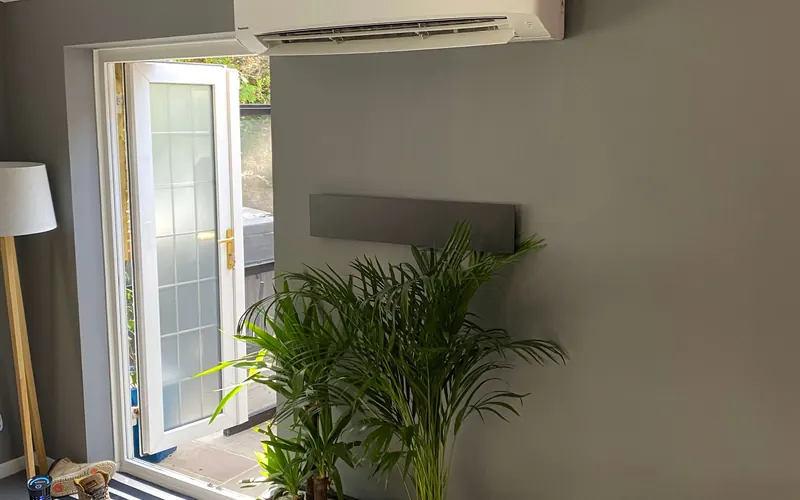
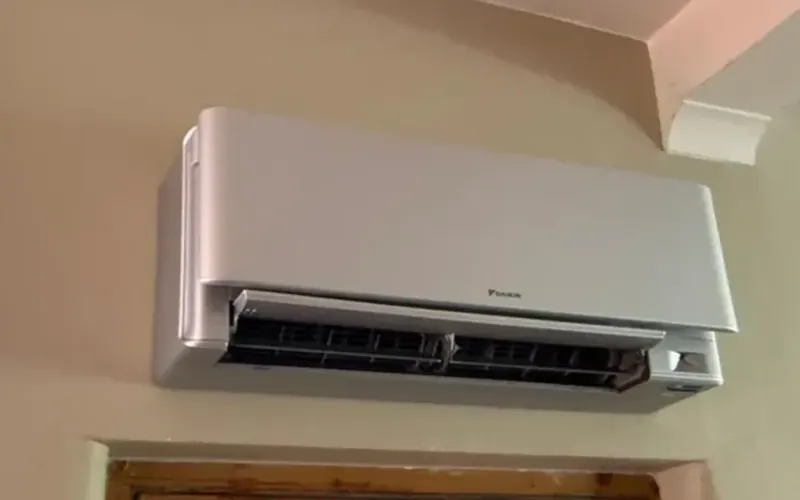
Wall-mounted split: the default
An indoor unit high on the wall, an outdoor unit outside, and refrigerant pipework between them, fitted by an F gas certified firm. A reversible model heats as well as cools, which makes it an air-to-air heat pump in all but name. Our air-to-air heat pump guide and split system guide cover how that works, and air conditioning vs a heat pump covers the buying decision.
Portable: the weakest option for sleep
A portable puts the compressor and fan in the bedroom and vents hot air through a hose in the window. The Energy Saving Trust warns that any gap around the hose lets warm air back in, and says: "Running a portable air conditioner costs up to 20 times more than a fan, so only use it when you really need it."
A retailer listing for De'Longhi's 10,000 BTU Pinguino PAC EX100 Silent gives a noise pressure of 49 to 53 dB(A), min to max. That is a retailer figure: we read no manufacturer data sheet. For a renter who cannot drill through a wall, a portable may still be the only option.
Through-wall and loft-ducted
The Energy Saving Trust describes all-in-one (monobloc) units that need no outdoor unit, with two ducts through the wall needing holes about 15 to 20 cm wide. We read no noise data for them and make no noise claim. For upstairs bedrooms, a ducted system in the loft puts the unit outside the room. Here4Heat publishes "Installed from £6,999" for cooling one to three bedrooms. That is an installer's published figure, not a quote.
| Type | Where the noisy parts sit | Planning | Running-cost evidence | Suits |
|---|---|---|---|---|
| Wall-mounted split | Fan in the room, compressor outside | Reversible models can fit permitted development | Daikin data sheet input, our sums below | Owners, long-term tenants with consent |
| Portable | Compressor and fan in the room | None needed | Energy Saving Trust: £4.62 to £5 per 24 hours | Renters who cannot drill |
| Through-wall | Not established, no data read | Not established | Not established | Only after checking a data sheet |
| Loft-ducted | Unit in the loft, outlets in the room | Check with the council | None read | Upstairs rooms, larger budgets |
How quiet is quiet enough for sleep?
The quietest air conditioner on paper is not always the quietest one in your room, mostly because of which number you are looking at.
The target: 30 dB LAeq inside the bedroom
WHO community noise guidance (1999) sets 30 dB LAeq for steady background noise inside a bedroom, plus a limit of 45 dB LAmax for single noise events. We read the text in an online copy of the 1995 working draft (Berglund and Lindvall), because the WHO PDF would not load. UK building acoustics guidance (BS 8233) is reported in planning noise assessments to use the same 30 dB figure, though we did not read the standard itself.
The HSE says you might just notice a 3 dB change, and that every 3 dB doubles the noise. That describes the energy in the sound, not how loud it seems.
Three decibel figures that look alike and are not
Three different measures turn up in brochures and on labels.
Indoor sound pressure, 1 m from the unit. This is the number in the headline. Daikin's Perfera product profile lists 19 dBA at its Silent setting, and quotes "down to 19dBA". The data sheet runs up to 47 dBA at High across the range. On the smallest sizes, the Silent, Low and High figures are 19, 25 and 41 dBA. Mitsubishi Electric's service manual for the MSZ-AP25VG gives 19, 24, 30, 36 and 42 dB(A) for Silent, Low, Medium, High and Super High.
Sound power, on the UK energy label. The retained energy label regulation for air conditioners requires the label to show sound power, in dB(A) re 1 pW, not sound pressure. Daikin's Perfera sheet gives indoor sound power of 57 to 60 dBA. So 19 and 57 can describe the same unit. They measure different things: one is what a microphone 1 m away reads, the other is the total noise the unit radiates. If you compare a label figure with a brochure figure, the quieter-looking unit may simply be quoting the smaller measure.
The outdoor unit. Daikin lists nominal outdoor sound pressure of 46 to 49 dBA in cooling, and outdoor sound power of 58 to 61 dBA.
| Source | Measure | dB(A) | Against 30 dB |
|---|---|---|---|
| WHO community noise guidance | Bedroom target, steady | 30 | Target |
| Daikin Perfera, smallest sizes | Indoor pressure, Silent | 19 | Below |
| Daikin Perfera, smallest sizes | Indoor pressure, Low | 25 | Below |
| Daikin Perfera, smallest sizes | Indoor pressure, High | 41 | Above |
| Daikin Perfera, top of range | Indoor pressure, High | 47 | Above |
| Mitsubishi MSZ-AP25VG | Silent, Low | 19, 24 | Below |
| Mitsubishi MSZ-AP25VG | Medium | 30 | At target |
| Mitsubishi MSZ-AP25VG | High, Super High | 36, 42 | Above |
| Portable, retailer listing | Sound pressure, min to max | 49 to 53 | Above |
| Daikin Perfera | Outdoor unit, nominal | 46 to 49 | Outside the room |
These are test figures at 1 m, not at your pillow, and a real room adds reflections. Daikin and Mitsubishi Electric are examples of a data sheet, not recommendations: we have no test data and do not rank brands. The Energy Saving Trust adds: "Indoor units can be noisier than other heat pumps."
On paper, a small split sits under the 30 dB target on its low settings and above it on high. A portable sits above it at every setting listed.
The outdoor unit is a bedroom problem too
The outdoor unit sits somewhere, and that somewhere is often under a window. For heat pumps, the MCS 020 a) noise test sets 37 dB LAeq over five minutes at a point 1 m outside a neighbour's habitable-room window. It is a calculation from the unit's sound power, not a measurement taken on site. Ask the installer for the written calculation.
Mitsubishi Electric's manual says its night mode limits the outdoor unit's noise. The WHO Night Noise Guidelines for Europe (2009) use an outdoor night target of 40 dB.
If the noise becomes a dispute, DEFRA says a statutory nuisance is noise that can "unreasonably and substantially interfere with the use or enjoyment of a home". Councils must serve an abatement notice if they agree.
What size for a bedroom?
Bigger is not better here. Daikin says an oversized unit cycles on and off, with higher cost and wear.
Worked example: an average bedroom
Take a bedroom 4 m by 3.5 m, so 14 m2, with two people, average insulation and a 2.4 m ceiling. Our calculator method uses 90 W per m2 for average insulation, which gives 14 x 90 = 1,260 W, or 1.3 kW (about 4,300 BTU). The smallest common unit is 2.0 kW (about 6,800 BTU). Daikin's rule of thumb of about 0.1 kW per m2 gives 1.4 kW, close to our sum.
Worked example: a hot top-floor room
Same room, but poor insulation, a very sunny aspect and a top-floor position. The method uses 115 W per m2 for poor insulation, then multiplies by 1.3 for very sunny and 1.15 for a top floor.
| Case | Sum | Result | Unit |
|---|---|---|---|
| Average room | 14 m2 x 90 W | 1,260 W, 1.3 kW, about 4,300 BTU | 2.0 kW |
| Hot top-floor room | 14 m2 x 115 W x 1.3 x 1.15 | 2,407 W, 2.4 kW, about 8,200 BTU | 2.5 kW |
The method uses 70, 90 and 115 W per m2 for well, average and poor insulation at 2.4 m ceilings, 1.15 for a sunny room, 1.3 for a very sunny one, 1.15 for a top floor, and 100 W for each person beyond two. It is our own calculator's method, not a standard. Run your own room through the BTU calculator.
Reading BTU and kW figures
A "9,000 BTU" portable is about 2.6 kW nominal, because 1 kW is 3,412 BTU per hour. Daikin's Perfera 20-size range runs 1.3 kW at minimum, 2.0 kW nominal and 2.6 kW at maximum, so a small inverter unit already turns down well below its headline figure.
Settings and placement for sleeping
Night modes are not the same thing
Daikin's night set mode "prevents overheating or overcooling during the night", and with the timer on it sets the temperature 0.5°C warmer when cooling. Mitsubishi Electric's night mode dims the indicator light, disables the beep and limits the outdoor unit's noise. Check the manual for the unit you are buying.
Set point: there is no official UK number
We found no official UK target for an adult's bedroom temperature. The NHS says only "cool". Figures repeated online are not NHS advice for adults. Pick a temperature at which you are comfortable, not cold, and use the timer.
Where the indoor unit goes
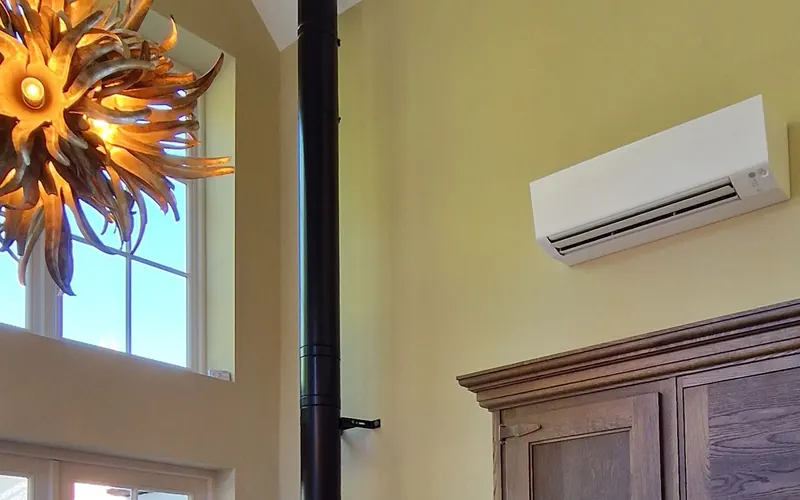
The Energy Saving Trust says the indoor unit usually sits high on a wall, as close to the outdoor unit as possible, which keeps pipework inside the house short. Our own advice, not a sourced rule: avoid mounting it directly over the headboard, and ask the installer to aim the louvres away from the bed.
Where the outdoor unit goes, doors and overnight use
Put the outdoor unit away from your own bedroom window and from the neighbours' windows. Keep internal doors closed while the unit runs, as the Energy Saving Trust advises, so it does not fight warm air from the rest of the house.
We found no UK data on typical overnight consumption. The 93p figure below is a ceiling at full input.
What it costs to buy and run
Buying
Aircon4Homes states on its own site: "A typical single-room split-system installation starts from £1,650 supply and fit." Other published figures follow. These are published prices, not quotes, and most local pages do not state their VAT status.
| Source | Figure | What it includes | Date read |
|---|---|---|---|
| Aircon4Homes (Eastbourne) | From £1,650 | Single bedroom, 2.5 kW, supply, installation and commissioning | 10 Oct 2026 |
| Eaglereach Mechanical (Hove) | £1,350 to £2,500 | Wall-mounted split, fully fitted | 10 Oct 2026 |
| Ernest Air Cooling (Shoreham) | £1,899 to £2,500 | Single split, installed | 10 Oct 2026 |
| Sussex Air Conditioning & Heat Pumps | £1,200 to £1,800 | Bedroom or small office, fully installed | 10 Oct 2026 |
| Preferred Cooling | £1,000 to £2,500 | Single wall-mounted split, fully installed | 10 Oct 2026 |
| Here4Heat (Worthing) | From £2,149 | Wall-mounted, installed | 10 Oct 2026 |
| Energy Saving Trust | About £1,900 | One room, air-to-air heat pump | 10 Oct 2026 |
| Trade2Base (blog, 1 Jul 2026) | £1,800 to £3,500 | Single split, installed | 10 Oct 2026 |
| Heatable | £2,000 to £3,500 | Single split, installed | 10 Oct 2026 |
| Airtasker (updated 25 Aug 2026) | £1,500 to £3,000 | Single-room split | 10 Oct 2026 |
| Checkatrade | £2,250 | Double bedroom | 10 Oct 2026 |
Across the six Brighton-area installers in our directory that publish one, single-room split prices run from about £1,000 to £2,500, and national guides sit higher. For the wider picture, see our air conditioning cost guide and the cost calculator.
Running
Daikin's Perfera data sheet gives a nominal cooling input of 0.44 kW for the 2.0 kW unit and 0.56 kW for the 2.5 kW unit. Ofgem's price cap from 1 October to 31 December 2026 is 26.32p per kWh on average, excluding the 54.83p daily standing charge. A new cap applies from 1 January 2027.
| Unit | Input | Per hour | Per 8 hours |
|---|---|---|---|
| 2.0 kW split | 0.44 kW | 11.6p | About 93p |
| 2.5 kW split | 0.56 kW | 14.7p | About £1.18 |
| Typical portable (Energy Saving Trust) | Not stated | Not stated | About £1.54 to £1.67 |
The first two rows are our arithmetic and a ceiling, since they assume the unit runs at full nominal input all night. The portable row is the Energy Saving Trust's £4.62 to £5 per 24 hours divided by three, which assumes a constant draw. Check your own numbers in the running costs calculator, or read the running costs guide.
Loft and extra rooms cost more
Heatable puts a loft room at £2,500 to £3,500 or more. Extra electrical work adds £200 to £1,000, and an extra room on a multi-split adds about £800 to £1,200. Ask for each as a separate line.
The rules: planning, leases, noise and who can fit it
This section covers England. It is general information, not legal advice, so check with the council or a solicitor for your own case.
Planning
Under Class G of the permitted development rules, as amended, one condition is that the unit is "not solely used for the purpose of cooling". A cooling-only unit therefore needs an application, while a reversible split can often be fitted without one. That wording was added by the 2025 amendment order, which we read on 10 October 2026.
Listed buildings, conservation areas and flats differ. Brighton and Hove City Council says an air source heat pump on an unlisted home in a conservation area is not permitted development on a wall or roof that fronts a highway. Our Brighton and Hove planning guide sets this out, and heating with air conditioning covers the reversible side.
A £2,500 Boiler Upgrade Scheme grant for air-to-air heat pumps exists on paper, but the Energy Saving Trust says grants for them are not available yet, and on 10 October 2026 MCS's consumer page said no installers were yet certified for them. See the air-to-air heat pump grant guide before paying for anything on the strength of it.
Flats, leases and renting
Planning permission and a lease are separate matters. Mishcon de Reya (8 July 2026) says that if the works involve drilling through an external wall, the landlord's consent is likely to be required. Checkatrade says permanent installation usually needs landlord permission for renters, and calls a portable a workaround. See our air conditioning in flats guide.
Who is allowed to fit it
GOV.UK says a company "must be certified by an approved body to service stationary equipment containing F gas", and individual engineers need qualifications too. The approved bodies include REFCOM, Quidos and Bureau Veritas. Our F gas register guide shows how to look a firm up. "Not found on the register" is not the same as "not certified", because a company may have chosen not to be listed.
If you are in Brighton and Hove, you can see which installers we found on the REFCOM register on our installer pages.
How to get a fair bedroom quote
- Measure the room and run the size sum above, so you can tell a quote for 2.0 kW from one for 3.5 kW.
- Ask for the data sheet noise at low fan speed, as sound pressure at 1 m, and for the sound power figure.
- Ask for the written MCS 020 a) outdoor noise calculation.
- Ask for the firm's F gas certificate number and check it on the register.
- Get three itemised quotes that state pipe run, electrical work and VAT.
What we could not confirm
- Portable noise is from a retailer listing, and we found no noise data for through-wall units.
- There is no official UK set-point for an adult's bedroom, and no good primary source on other health effects.
- We did not read the WHO 1999 PDF or BS 8233 directly, and we tested no unit.
Questions
What size of air conditioning for bedroom use do I need?
How loud is too loud for an air conditioner in a bedroom?
Is it better to leave air conditioning on or off at night?
Should bedroom doors be closed when air conditioning is on?
Is it safe to sleep with air conditioning on?
Is air conditioning noisy for neighbours?
How can I cool my bedroom without air conditioning?
Sources
- Community Noise, Berglund and Lindvall, WHO working text (read 10 Oct 2026)
- Guidelines for Community Noise, WHO, 1999, catalogue page (read 10 Oct 2026)
- Night Noise Guidelines for Europe, WHO Europe, 2009 (read 10 Oct 2026)
- Noise: advice overview, HSE (read 10 Oct 2026)
- How to fall asleep faster and sleep better, NHS Every Mind Matters (read 10 Oct 2026)
- Effects of thermal environment on sleep and circadian rhythm, Okamoto-Mizuno and Mizuno, J Physiol Anthropol 2012 (read 10 Oct 2026)
- Beat the heat: keep cool at home checklist, UKHSA, updated 21 July 2026 (read 10 Oct 2026)
- Tips to keep your home cool this summer, Energy Saving Trust, 18 June 2026 (read 10 Oct 2026)
- Air-to-air heat pumps, Energy Saving Trust, updated 11 September 2026 (read 10 Oct 2026)
- Perfera wall mounted unit product profile ECPEN22-008, Daikin UK (read 10 Oct 2026)
- Air conditioner size guide, Daikin UK (read 10 Oct 2026)
- MSZ-AP25VG service manual OBH788, Mitsubishi Electric UK (read 10 Oct 2026)
- Delegated Regulation 626/2011, Annex III, energy labelling of air conditioners, legislation.gov.uk (read 10 Oct 2026)
- BTU calculator, Air Con Guide (read 10 Oct 2026)
- Changes to the energy price cap between 1 October and 31 December 2026, Ofgem, 26 August 2026 (read 10 Oct 2026)
- How to price air conditioning installation in the UK, Trade2Base, 1 July 2026 (read 10 Oct 2026)
- Air conditioning costs, Heatable (read 10 Oct 2026)
- Air conditioner installation cost, Airtasker, updated 25 August 2026 (read 10 Oct 2026)
- Air conditioning in Brighton, Checkatrade (read 10 Oct 2026)
- Air conditioning installation Brighton, Aircon4Homes (read 10 Oct 2026)
- De'Longhi Pinguino PAC EX100 Silent listing, BLT Direct (read 10 Oct 2026)
- How much does it cost to install air conditioning, Eaglereach Mechanical (read 10 Oct 2026)
- Air conditioning services, Ernest Air Cooling (read 10 Oct 2026)
- Air conditioning installation, Sussex Air Conditioning & Heat Pumps (read 10 Oct 2026)
- Domestic air conditioning, Preferred Cooling (read 10 Oct 2026)
- Bedroom air conditioning, Here4Heat (read 10 Oct 2026)
- Conservation areas and listed buildings: energy saving, Brighton and Hove City Council (read 10 Oct 2026)
- MCS 020 a), Issue 1.1, MCS (read 10 Oct 2026)
- Town and Country Planning (General Permitted Development etc.) (England) (Amendment) Order 2025, SI 2025/560, legislation.gov.uk (read 10 Oct 2026)
- Air-to-air heat pumps, MCS consumer page (read 10 Oct 2026)
- Noise nuisances: how councils deal with complaints, DEFRA, updated 21 December 2017 (read 10 Oct 2026)
- Certification for companies working on equipment containing F gas, GOV.UK (read 10 Oct 2026)
- Keeping cool: what to think about before installing air conditioning, Mishcon de Reya, 8 July 2026 (read 10 Oct 2026)
Written and checked by Alex Christou. Found a mistake? Tell us; our corrections policy explains what happens next.